
Workplace Harassment Proceedings and Departmental Inquiries: Islamabad High Court Explains the Difference
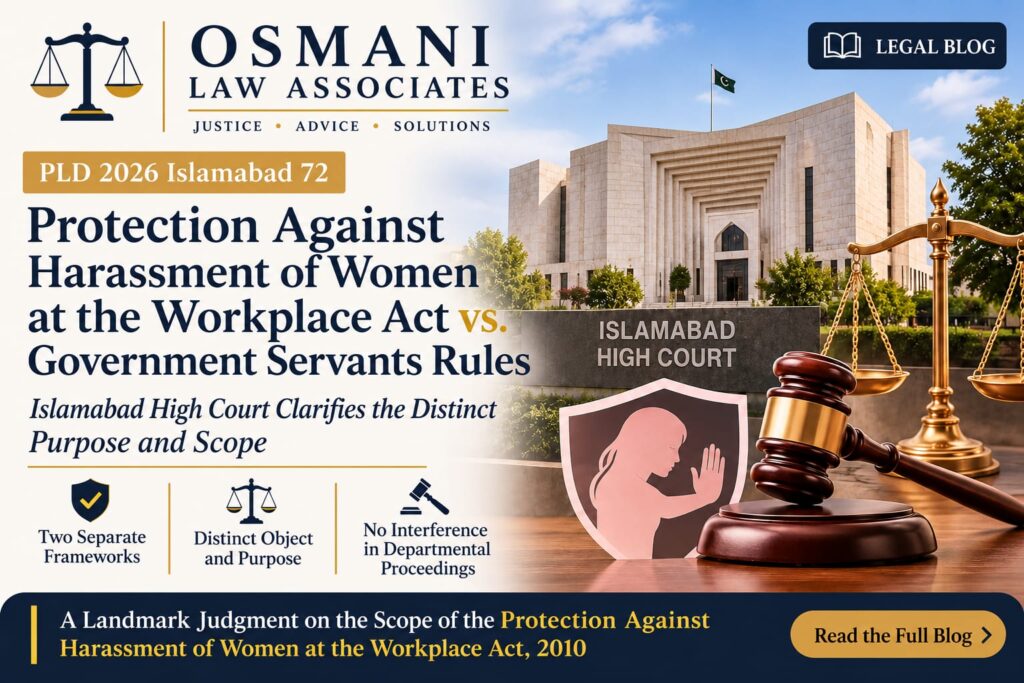
Case: Mirza Salman Babar Beg v. Federation of Pakistan and others
Citation: PLD 2026 Islamabad 72
Court: Islamabad High Court
Judge: Mr. Justice Babar Sattar
Case No.: Writ Petition No. 2465 of 2023
Decision Date: 3 November 2025
Introduction
Can a government employee face departmental disciplinary proceedings and proceedings under the Protection Against Harassment of Women at the Workplace Act, 2010, on the basis of the same allegations?
In an important judgment reported as PLD 2026 Islamabad 72, in Mirza Salman Babar Beg v. Federation of Pakistan and others, the Islamabad High Court examined the distinct legal purposes of departmental disciplinary proceedings under the Government Servants (Efficiency and Discipline) Rules, 1973, and proceedings under the Protection Against Harassment of Women at the Workplace Act, 2010.
Justice Babar Sattar explained that these two legal frameworks operate independently and serve different objectives. Even where the allegations and possible penalties overlap, the existence of one proceeding does not automatically invalidate or prevent the other.
The judgment provides important guidance on workplace harassment complaints, government employees’ service matters, departmental inquiries, and the legal framework governing misconduct in public service.
Background of the Case
The petitioner, Mirza Salman Babar Beg, a civil servant, approached the Islamabad High Court through a constitutional petition under Article 199 of the Constitution of Pakistan.
He challenged a show-cause notice issued in connection with departmental disciplinary proceedings concerning allegations of sexual harassment involving a female employee.
The matter raised an important legal question: whether proceedings under the Government Servants (Efficiency and Discipline) Rules, 1973, could be initiated or continued when the underlying allegations also attracted the provisions of the Protection Against Harassment of Women at the Workplace Act, 2010.
Legal Frameworks Examined by the Court
1. Government Servants (Efficiency and Discipline) Rules, 1973
The Court explained that proceedings under the Government Servants (Efficiency and Discipline) Rules, 1973, are essentially a matter between the government, acting as an employer, and a civil servant, acting as an employee.
Their primary purpose is to ensure that government employees comply with the applicable service conditions and standards of conduct while performing their official responsibilities.
These proceedings address questions of service discipline, professional conduct, and misconduct within the employment relationship.
2. Protection Against Harassment of Women at the Workplace Act, 2010
The Court distinguished the above framework from the Protection Against Harassment of Women at the Workplace Act, 2010.
The Act was enacted with a separate and important objective: protecting women from harassment at the workplace.
The Court observed that proceedings under this legislation are adversarial in nature. A complainant brings allegations against an accused person, and those allegations must be established through cogent evidence.
Where the allegations are proved, the consequences and penalties prescribed under the 2010 Act may follow.
Thus, the legislation is not merely another mechanism for enforcing government employees’ service discipline. It serves the broader statutory purpose of protecting women against workplace harassment.
Can Both Proceedings Exist Simultaneously?
One of the most significant aspects of this judgment is the Court’s recognition that departmental disciplinary proceedings and workplace harassment proceedings can operate independently.
The two proceedings may arise from the same set of facts. However, their legal objectives, nature, and consequences are different.
The departmental proceedings examine whether a civil servant has violated the standards of conduct applicable to their service.
On the other hand, proceedings under the 2010 Act examine allegations of workplace harassment under the specific statutory framework established for that purpose.
The Court also acknowledged that penalties under Section 4 of the 2010 Act may be similar to, or overlap with, penalties under the Government Servants (Efficiency and Discipline) Rules, 1973.
However, such an overlap does not change the distinct purpose, scope, or legal effect of the two proceedings.
The important principle is that similarity in penalties does not make two separate legal proceedings identical.
Court’s Decision
The Islamabad High Court declined to interfere with the show-cause notice issued to the petitioner.
The Court held that departmental disciplinary proceedings under the Government Servants (Efficiency and Discipline) Rules, 1973, and proceedings under the Protection Against Harassment of Women at the Workplace Act, 2010, serve different purposes and must be understood within their respective legal frameworks.
Consequently, the constitutional petition was dismissed.
Important Legal Principles Established
The judgment provides several important legal takeaways:
- Independent legal frameworks: Departmental disciplinary proceedings and workplace harassment proceedings have distinct objectives and operate under separate legal frameworks.
- Different purposes: Service rules regulate the conduct and discipline of government employees, whereas the 2010 Act aims to protect women from workplace harassment.
- Adversarial nature: Proceedings under the Protection Against Harassment of Women at the Workplace Act, 2010, require allegations to be established through cogent evidence.
- Overlap of penalties: Similarity or overlap between the penalties prescribed under the two laws does not eliminate their separate legal character.
- No automatic bar: The existence of proceedings under one legal framework does not, by itself, prevent proceedings under the other.
- Constitutional jurisdiction: The High Court declined to interfere with the departmental show-cause notice in the circumstances of this case.
Why This Judgment Matters ?
This decision is significant for government departments, civil servants, employers, employees, legal practitioners, and individuals dealing with workplace harassment matters.
It clarifies that workplace harassment is not exclusively a matter of internal departmental discipline. It is also governed by a separate statutory framework designed to protect women and address workplace harassment through legally prescribed procedures.
For government departments, the judgment reinforces the distinction between enforcing service discipline and addressing workplace harassment under the relevant legislation.
For civil servants, it highlights that allegations of misconduct may have consequences under more than one applicable legal framework.
For complainants, it emphasizes the independent statutory mechanism available under the Protection Against Harassment of Women at the Workplace Act, 2010.
In Mirza Salman Babar Beg v. Federation of Pakistan and others (PLD 2026 Islamabad 72), the Islamabad High Court clarified an important distinction between departmental disciplinary proceedings and statutory workplace harassment proceedings.
The central takeaway is that two proceedings may arise from the same allegations without becoming legally identical. Their purposes, procedures, and legal consequences must be assessed independently.
The judgment reinforces the importance of maintaining workplace discipline while ensuring that the statutory protections against harassment remain effective.
Legal Insight: Different legal proceedings can arise from the same facts when they serve distinct statutory purposes. The overlap of allegations or penalties alone does not make one proceeding a substitute for the other.
About Osmani Law Associates
Nawaz Osmani Law Associates provides legal insight and professional legal services across a range of legal matters. We believe that understanding judicial decisions and their practical implications is essential for protecting legal rights and promoting access to justice.
For legal assistance relating to service matters, departmental inquiries, employment disputes, and workplace harassment proceedings,
Contact- Osmani Law Associates.
Cell & Whatsapp # +92321-2770225,
Email: info@osmanilaw.com
Website: www.osmanilaw.com