
KHULA, WOMEN’S RIGHTS & MODERN FAMILY LAW IN PAKISTAN BY SUPREME COURT
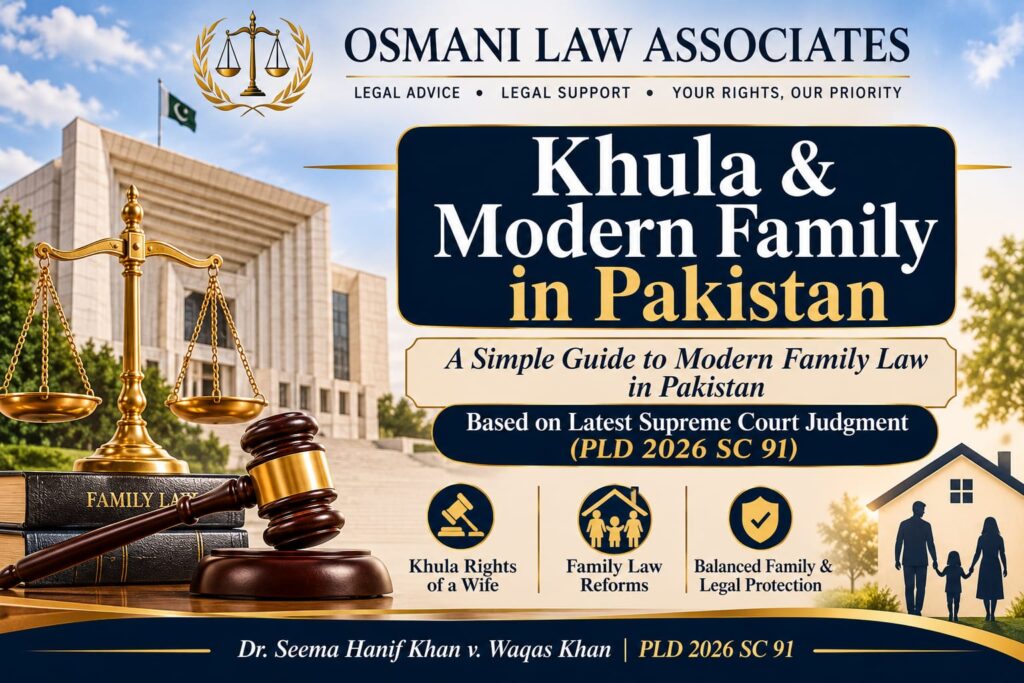
A Simple Guide Based on the Latest Supreme Court Judgment (PLD 2026 SC 91)
Introduction
Marriage is built on mutual trust, respect, and companionship. When that relationship irretrievably breaks down, the law provides remedies to protect the rights and dignity of both spouses. In a landmark judgment reported as PLD 2026 Supreme Court 91, the Supreme Court of Pakistan has reaffirmed the constitutional and Islamic principles governing Khula, women’s autonomy, cruelty in marriage, maintenance, and second marriages.
The judgment represents a progressive interpretation of Pakistani family law by recognizing that marriage cannot continue through coercion and that women possess independent legal rights guaranteed under the Constitution of Pakistan and Islamic jurisprudence.
At Osmani Legal, we simplify important judicial decisions to help individuals, families, legal practitioners, and professionals understand their legal rights under Pakistani family law.
Case at a Glance
Case Citation: PLD 2026 Supreme Court 91
Court: Supreme Court of Pakistan
Subject: Khula, Women’s Rights, Cruelty, Maintenance & Family Law
Relevant Laws
- Family Courts Act, 1964
- Muslim Family Laws Ordinance, 1961
- Dissolution of Muslim Marriages Act, 1939
- Constitution of the Islamic Republic of Pakistan, 1973
- Islamic Principles governing Khula
What is Khula?
Khula is the legal right of a Muslim wife to seek dissolution of her marriage through the Family Court where she is no longer willing to continue the marital relationship.
The Supreme Court reaffirmed that:
✔️ A wife is not required to prove extreme physical cruelty before obtaining Khula.
✔️ If the marital relationship has irretrievably broken down and reconciliation is no longer possible, the Family Court may dissolve the marriage.
Key Principle
Marriage under Islamic law is founded upon mutual consent, affection, and respect—not compulsion.
A spouse cannot be compelled to remain in a marriage that has become impossible to sustain.
How Do Family Courts Decide Matrimonial Cases?
One of the most significant observations made by the Supreme Court concerns the standard of proof in family litigation.
Unlike criminal proceedings, matrimonial disputes are decided on:
✔️ Balance of probabilities
rather than
❌ Proof beyond reasonable doubt.
This means the Family Court considers what is more likely to have happened after examining the overall circumstances.
The Court emphasized that family litigation should not become unnecessarily technical where justice requires practical and humane consideration.
Understanding Cruelty in Marriage
The Supreme Court expanded the legal understanding of cruelty.
Cruelty is not confined to physical violence.
It may also include:
- Emotional abuse;
- Psychological pressure;
- Persistent neglect;
- Humiliation;
- Lack of respect;
- Conduct making married life intolerable;
- Continuous mental suffering.
Importantly, cruelty must be assessed from the wife’s perspective, taking into account:
- Her education;
- Social background;
- Lifestyle;
- Emotional well-being; and
- Personal circumstances.
Every marriage is different, and courts must evaluate each case on its own facts.
Second Marriage Without Permission
The judgment also addressed the legal consequences of contracting a second marriage without complying with Pakistani law.
Under the Muslim Family Laws Ordinance, 1961, a husband intending to contract another marriage is generally required to obtain prior permission from the competent Arbitration Council.
Failure to comply may:
✔️ Constitute a violation of statutory requirements;
✔️ Cause serious emotional and financial hardship to the first wife;
✔️ Amount to matrimonial cruelty in appropriate circumstances; and
✔️ Strengthen a wife’s claim for dissolution of marriage or other legal relief.
The Court reiterated that the law seeks to protect fairness and justice within the family institution.
Women’s Autonomy and Fundamental Rights
One of the most progressive aspects of the judgment is the Supreme Court’s recognition of women’s independence and constitutional dignity.
The Court observed that marriage does not extinguish a woman’s individual identity or her constitutional rights.
Accordingly:
✔️ A woman has the right to pursue education.
✔️ She may lawfully pursue employment or a professional career.
✔️ Exercising personal choices within lawful limits does not amount to disobedience.
✔️ Marriage is a partnership based upon mutual respect and equality.
The Court emphasized that constitutional guarantees continue to protect women after marriage.
Maintenance (Financial Support)
The Supreme Court reaffirmed the well-established legal principle that a wife is entitled to maintenance according to law.
Maintenance includes financial support necessary for:
- Food;
- Clothing;
- Residence;
- Medical care; and
- Basic necessities of life.
The Court clarified that maintenance is a legal obligation arising from marriage and must be determined according to the facts of each case and the applicable law.
Why This Judgment is Important
This landmark decision significantly strengthens the protection available to women under Pakistani family law.
It confirms that:
✔️ Marriage cannot be preserved through coercion.
✔️ Emotional suffering deserves legal recognition.
✔️ Women’s dignity remains protected under Islamic and constitutional principles.
✔️ Family Courts should adopt a practical, rights-based approach when deciding matrimonial disputes.
The judgment also provides greater certainty for lawyers and Family Courts in interpreting the law relating to Khula and matrimonial cruelty.
Who Can Benefit from This Judgment?
Women Seeking Khula
The decision makes it clear that a wife is not required to endure an irretrievably broken marriage merely because there is no evidence of physical violence.
Families
The judgment promotes reconciliation where possible while ensuring that justice prevails when marital relationships become impossible to continue.
Legal Practitioners
The Supreme Court provides valuable guidance regarding:
- Standard of proof;
- Interpretation of cruelty;
- Women’s autonomy;
- Maintenance claims; and
- Second marriages.
Corporate Professionals & Advisors
Family disputes often affect inheritance, succession, taxation, property ownership, and financial planning.
Understanding these legal principles assists professionals advising clients in related matters.
Key Legal Principles Established
The Supreme Court reaffirmed that:
✔️ Khula is a legal right recognised under Islamic law and Pakistani law.
✔️ Family Courts decide cases on the balance of probabilities.
✔️ Cruelty includes emotional and psychological suffering.
✔️ Marriage cannot continue against the free will of either spouse.
✔️ Women retain their constitutional rights after marriage.
✔️ Maintenance is a legally enforceable obligation.
✔️ Second marriages must comply with statutory requirements.
✔️ Family law must be interpreted in a manner consistent with justice, dignity, and equality.
Our Professional View
At Osmani Legal, we consider PLD 2026 Supreme Court 91 to be one of the most significant family law judgments in recent years.
The decision reinforces the constitutional values of dignity, equality, and justice while harmonizing Islamic principles with contemporary realities. It recognizes that matrimonial disputes involve not only legal questions but also profound human and emotional considerations.
The judgment provides greater clarity for litigants, Family Courts, and legal practitioners, ensuring that family law remains responsive to the evolving needs of society without departing from the principles of Islamic jurisprudence.
Conclusion
The Supreme Court has delivered a clear and compassionate message:
No individual should be compelled to remain in a marriage that has irretrievably broken down.
By reaffirming women’s legal autonomy, recognizing emotional cruelty, and clarifying the principles governing Khula, maintenance, and second marriages, the Court has strengthened the protection of fundamental rights within the institution of marriage.
This landmark judgment marks another important step towards a fair, balanced, and rights-based approach to family law in Pakistan.
Frequently Asked Questions (FAQs)
Can a woman obtain Khula without proving physical cruelty?
Yes. The Supreme Court has clarified that physical violence is not the only ground. If the marriage has irretrievably broken down and reconciliation is not possible, the Family Court may grant Khula.
What standard of proof applies in Family Court cases?
Family disputes are decided on the balance of probabilities, not the criminal standard of proof beyond reasonable doubt.
Does emotional abuse amount to cruelty?
Yes. Emotional and psychological suffering may constitute cruelty depending on the facts and circumstances of the case.
Can a husband contract a second marriage without permission?
Pakistani law generally requires compliance with the Muslim Family Laws Ordinance, 1961, including obtaining prior permission from the relevant Arbitration Council. Failure to do so may have legal consequences.
Does a married woman retain her constitutional rights?
Yes. Marriage does not extinguish a woman’s constitutional rights, including the right to education, employment, dignity, and equality.
Need Legal Assistance?
If you are facing issues relating to Khula, divorce, maintenance, child custody, guardianship, second marriage disputes, domestic violence, or family litigation, Osmani Law Associates provides experienced legal representation before Family Courts, High Courts, and the Supreme Court of Pakistan.
Our Family Law Services include:
- Khula Proceedings
- Divorce & Dissolution of Marriage
- Child Custody & Guardianship
- Maintenance Claims
- Dowry & Dower (Haq Mehr) Disputes
- Domestic Violence Matters
- Family Appeals
- Constitutional Petitions in Family Matters
- Succession & Inheritance
- Muslim Family Laws Ordinance Matters
Our dedicated family law team is committed to protecting your legal rights with profess
Contact- Osmani Law Associates.
Cell & Whatsapp # +92321-2770225,
Email: info@osmanilaw.com
Website: www.osmanilaw.com