
SHIP (VESSEL) ARREST IN PAKISTAN – COMPREHENSIVE GUIDE BY OSMANI LAW
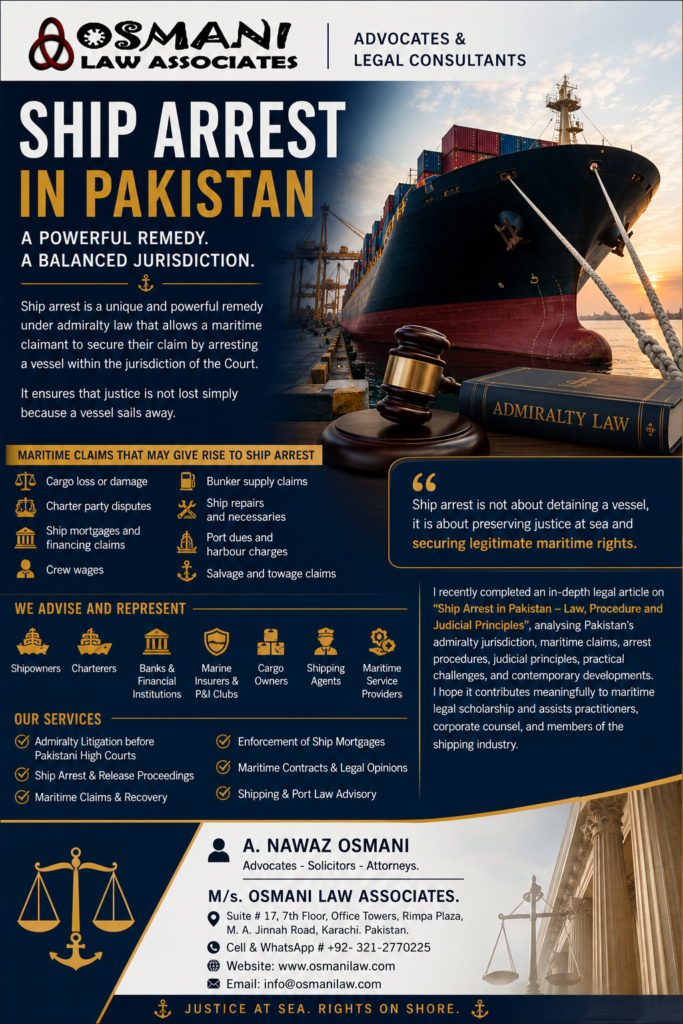
WHAT IS SHIP (VESSEL) ARREST IN PAKISTAN?
Part I – Introduction to Ship Arrest in Pakistan
Ship arrest is one of the most significant remedies available under admiralty law. It enables a competent court to detain a vessel as security for a maritime claim or to ensure the enforcement of a future judgment or arbitral award. Unlike ordinary civil litigation, admiralty proceedings permit legal action directly against a vessel, allowing the court to exercise jurisdiction over the ship itself in accordance with the applicable law.
The remedy of ship arrest plays a vital role in international shipping because vessels are mobile assets capable of leaving the jurisdiction within a short period. Without the availability of this remedy, many maritime claims would become difficult, if not impossible, to enforce.
Importance of Ship Arrest in Pakistan’s Maritime Industry
Pakistan occupies a strategically important position along the Arabian Sea, serving as a gateway for international trade between Asia, the Middle East, Africa, and Europe. Every year, numerous commercial vessels enter Pakistani ports carrying containers, petroleum products, bulk cargo, machinery, agricultural commodities, and other goods essential to the country’s economy.
Given the substantial commercial interests involved, disputes frequently arise concerning freight, cargo damage, ship mortgages, charter parties, unpaid crew wages, bunker supplies, salvage operations, port charges, marine insurance, and contractual obligations. Ship arrest provides an effective legal mechanism for protecting the rights of parties involved in these maritime transactions and preserving the subject matter of litigation until the dispute is resolved.
Legal Significance of Ship Arrest Proceedings
Ship arrest is not intended to punish a shipowner or interfere unnecessarily with commercial shipping operations. Instead, it is a judicial remedy designed to balance the competing interests of claimants and vessel owners by securing maritime claims while ensuring that justice can be effectively administered.
Because the detention of a commercial vessel may result in significant financial consequences, Pakistani courts exercise this jurisdiction cautiously. Applicants seeking the arrest of a ship must satisfy the legal requirements prescribed by the applicable admiralty laws and demonstrate that the claim falls within the recognised categories of maritime claims.
Admiralty Jurisdiction of Pakistani Courts
The power to arrest ships in Pakistan is exercised through the admiralty jurisdiction of the competent High Courts i.e. High Cour of Sindh, Karachi and High Court of Baluchistan, Quetta. This jurisdiction enables the courts to hear and determine disputes relating to ships, cargo, maritime contracts, marine insurance, collisions, salvage, mortgages, and other recognised maritime claims.
In appropriate cases, the Court may order the detention of a vessel until adequate security is furnished or the dispute is finally determined in accordance with law.
Common Maritime Claims Leading to Ship Arrest
Applications for ship arrest commonly arise from a variety of maritime disputes, including:
- Ship mortgage claims.
- Cargo loss or damage.
- Collision between vessels.
- Charter party disputes.
- Unpaid freight and hire charges.
- Crew wages and employment claims.
- Salvage and towage services.
- Bunker supply disputes.
- Port dues and harbour charges.
- Marine insurance claims.
- Shipbuilding and ship repair disputes.
- Claims arising from maritime liens and other recognised maritime obligations.
The precise nature of the claim determines whether the Court has jurisdiction to order the arrest of a vessel.
Why Ship Arrest is a Powerful Legal Remedy
Unlike many other forms of litigation, maritime disputes often involve foreign shipowners and vessels that may depart Pakistan before legal proceedings are concluded. Ship arrest enables a claimant to secure its legal position by preventing the vessel from leaving the jurisdiction until appropriate security has been provided or the court orders its release.
This remedy protects the effectiveness of judicial proceedings while encouraging parties to resolve disputes promptly and in accordance with applicable maritime law.
Scope of This Comprehensive Guide
This guide provides a detailed explanation of ship arrest proceedings in Pakistan, including:
- The legal framework governing ship arrest.
- Admiralty jurisdiction of Pakistani High Courts.
- Maritime claims recognised under Pakistani law.
- Procedure for arresting a vessel.
- Documents required for ship arrest.
- Arrest of sister ships.
- Security for the release of an arrested vessel.
- Wrongful arrest and its legal consequences.
- Release of ships from judicial arrest.
- Appeals and remedies.
- Practical litigation strategies.
- Frequently asked questions.
- Landmark judicial principles governing admiralty proceedings.
The objective of this guide is to provide business owners, shipowners, charterers, banks, insurers, cargo interests, overseas Pakistanis, maritime professionals, law students, and legal practitioners with a practical understanding of ship arrest proceedings in Pakistan.
Why Clients Choose Osmani Law Firms for Maritime Litigation
Maritime disputes require prompt legal action, commercial awareness, and a thorough understanding of admiralty law and court procedure. At Osmani Law Firms, we advise and represent clients in maritime and commercial disputes involving ship arrest, cargo claims, shipping contracts, marine insurance, banking matters, and related litigation before the competent courts in Pakistan.
Our objective is to provide practical, commercially focused legal solutions while safeguarding our clients’ rights and business interests through strategic litigation and professional legal representation.
Key Takeaways
Before exploring the legal framework governing ship arrest in Pakistan, readers should keep the following important principles in mind:
- Ship arrest is an extraordinary remedy under admiralty law that enables a competent High Court in Pakistan to detain a vessel as security for a recognised maritime claim.
- Ship arrest proceedings are designed to secure maritime claims, preserve the jurisdiction of the Court, and prevent a vessel from leaving Pakistan before the dispute is resolved or adequate security is furnished.
- Not every claim against a ship permits judicial arrest. The claim must generally qualify as a recognised maritime claim under the applicable admiralty laws and judicial principles.
- The admiralty jurisdiction of Pakistani High Courts extends to a wide range of maritime disputes, including ship mortgages, cargo damage, collision claims, salvage, crew wages, bunker supply, charter party disputes, marine insurance, port charges, and other maritime claims recognised by law.
- Ship arrest is not a determination of liability. It is an interim judicial measure intended to secure the claimant’s rights until the dispute is finally adjudicated or satisfactory security is provided.
- In appropriate circumstances, a shipowner may secure the release of an arrested vessel by furnishing acceptable security, such as a bank guarantee, cash deposit, protection and indemnity (P&I) club letter of undertaking (where accepted), or other security approved by the Court.
- Courts exercise the power of ship arrest with caution because detention of a commercial vessel may have significant commercial and financial consequences for shipowners, charterers, cargo interests, and other stakeholders.
- A wrongful or unjustified ship arrest may expose the claimant to claims for damages, costs, or other legal consequences, making it essential that every arrest application is prepared with care and supported by credible evidence.
- Applications relating to ship arrest often require urgent legal action, as vessels may leave Pakistani territorial waters or port limits within a short period if no judicial restraint is obtained.
- Maritime litigation frequently involves international parties, foreign-flagged vessels, cross-border contracts, marine insurance, and complex jurisdictional issues, requiring careful legal analysis and compliance with procedural requirements.
- Understanding the legal framework, procedural requirements, and judicial principles governing ship arrest proceedings in Pakistan enables shipowners, charterers, cargo owners, banks, insurers, and maritime businesses to protect their legal and commercial interests effectively.
- Early consultation with experienced maritime counsel can assist in assessing the merits of a maritime claim, obtaining urgent relief where appropriate, responding to arrest proceedings, and developing an effective litigation strategy before the competent courts in Pakistan.
Part III – Legal Framework Governing Ship Arrest in Pakistan
Ship arrest proceedings in Pakistan are governed by a combination of admiralty law, constitutional provisions, procedural statutes, judicial precedents, and internationally recognised maritime principles. Unlike ordinary civil litigation, admiralty jurisdiction involves specialized legal rules that allow the Court to exercise jurisdiction over a vessel and determine maritime claims.
Understanding the legal framework is essential for shipowners, charterers, banks, insurers, cargo owners, marine service providers, and legal practitioners involved in maritime disputes. This chapter explains the principal sources of law governing ship arrest proceedings in Pakistan.
Admiralty Jurisdiction of the High Courts
What is Admiralty Jurisdiction?
Admiralty jurisdiction refers to the special jurisdiction exercised by the competent High Courts to hear and determine maritime disputes. It empowers the Court to adjudicate claims relating to ships, cargo, marine commerce, maritime contracts, collisions, salvage operations, ship mortgages, and other recognised maritime claims.
Unlike conventional civil proceedings, admiralty actions may proceed in rem (against the vessel itself) or in personam (against the owner or other liable person), depending upon the nature of the claim and the applicable law.
Admiralty Jurisdiction in Pakistan
Pakistan inherited its admiralty jurisdiction from the legal framework developed during the British colonial period. After independence, this jurisdiction continued under Pakistani law and is now exercised by the competent High Courts in accordance with the Constitution, statutory provisions, and established judicial principles.
The High Courts possess the authority to:
- Arrest vessels within their territorial jurisdiction.
- Determine maritime claims.
- Order judicial sale of ships where legally permissible.
- Release vessels upon adequate security.
- Determine priorities among competing maritime claims.
- Enforce maritime liens and ship mortgages where recognised by law.
- Grant interim and ancillary relief necessary for the administration of justice.
The exercise of admiralty jurisdiction is intended to ensure that maritime disputes are resolved efficiently while balancing the commercial interests of shipowners and claimants.
Constitutional Basis of Admiralty Jurisdiction
The constitutional authority of the High Courts is derived from the Constitution of the Islamic Republic of Pakistan. While admiralty jurisdiction is primarily statutory, the constitutional powers of the High Courts enable them to administer justice, supervise subordinate courts where applicable, and exercise their jurisdiction in accordance with law.
The High Courts therefore possess both statutory admiralty powers and inherent judicial authority necessary for the effective administration of maritime justice.
Relevant Pakistani Statutes Governing Ship Arrest
Ship arrest proceedings are regulated by several statutes, each addressing different aspects of maritime law and judicial procedure.
Admiralty Jurisdiction of High Courts Ordinance, 1980
The Admiralty Jurisdiction of High Courts Ordinance, 1980 is the principal legislation governing admiralty proceedings in Pakistan. It defines the admiralty jurisdiction of the High Courts of Pakistan i.e. High Cour of Sindh, Karachi and High Court of Baluchistan, Quetta, identifies the categories of maritime claims, and provides the legal basis for the arrest and release of ships in appropriate cases.
The Ordinance also recognises actions against vessels and establishes procedural mechanisms for enforcing maritime rights before Pakistani courts.
Code of Civil Procedure, 1908 (CPC)
Although ship arrest proceedings arise under admiralty law, many procedural matters are governed by the Code of Civil Procedure, 1908, particularly where the Admiralty Ordinance does not provide a complete procedural framework.
The CPC regulates matters such as:
- Institution of proceedings.
- Service of notices.
- Interim relief.
- Judicial discretion.
- Recording of evidence.
- Execution of decrees.
- Appeals and revisions.
- Procedural safeguards.
Accordingly, admiralty proceedings often operate alongside the general procedural principles contained in the CPC.
Limitation Act, 1908
Maritime claims are also subject to statutory limitation periods. Failure to commence proceedings within the prescribed limitation period may affect the maintainability of the claim, subject to any exceptions recognised by law.
Accordingly, parties should seek legal advice promptly after a maritime dispute arises.
Merchant Shipping Laws
Pakistan’s merchant shipping legislation regulates matters relating to:
- Registration of ships.
- Safety standards.
- Seafarers’ rights.
- Navigation.
- Marine casualties.
- Administrative control of vessels.
- Various operational aspects of maritime commerce.
Although these laws do not themselves create every right of ship arrest, they frequently interact with admiralty proceedings where disputes concern vessel ownership, registration, operation, or statutory compliance.
Contract Act and Commercial Laws
Many maritime disputes arise from commercial agreements, including:
- Charter parties.
- Bills of lading.
- Marine insurance contracts.
- Shipbuilding agreements.
- Ship repair contracts.
- Cargo transportation agreements.
- Agency arrangements.
General principles of Pakistani contract law therefore often supplement admiralty proceedings.
International Maritime Conventions
Importance of International Maritime Law
Shipping is inherently international. A vessel may be owned in one country, registered in another, insured elsewhere, and trade across multiple jurisdictions. Consequently, maritime law has developed through numerous international conventions designed to promote consistency and legal certainty in cross-border shipping.
Pakistani courts may consider internationally recognised maritime principles where they are incorporated into domestic law or otherwise relevant to the issues before the Court.
International Convention Relating to the Arrest of Sea-Going Ships
One of the most influential international instruments concerning ship arrest is the convention dealing with the arrest of sea-going ships. It establishes internationally recognised principles regarding:
- Maritime claims.
- Jurisdiction.
- Arrest of vessels.
- Release against security.
- Rights of claimants.
- Protection of shipowners.
Although the application of international conventions in Pakistan depends upon domestic legal adoption and judicial interpretation, these instruments remain important sources of guidance in admiralty practice.
International Convention on Maritime Liens and Mortgages
This convention provides internationally accepted principles relating to:
- Maritime liens.
- Priority of claims.
- Ship mortgages.
- Rights of secured creditors.
- Judicial sale of vessels.
These principles frequently influence the resolution of maritime disputes involving competing claims against a vessel.
Other International Maritime Instruments
Depending upon the nature of the dispute, Pakistani courts may also consider internationally recognised maritime conventions relating to:
- Carriage of goods by sea.
- Marine pollution.
- Salvage.
- Limitation of liability.
- Safety of life at sea.
- Maritime security.
- Collision regulations.
The relevance of any particular convention depends upon whether it forms part of Pakistani law or is otherwise applicable to the dispute before the Court.
Interaction Between Domestic Law and International Maritime Practice
Modern admiralty litigation requires courts to balance domestic legislation with internationally recognised maritime principles. Since shipping is a global industry, consistency with accepted international practice promotes commercial certainty while safeguarding the rights of shipowners, cargo interests, financiers, insurers, and maritime service providers.
Pakistani courts therefore interpret admiralty legislation within the broader context of maritime commerce while ensuring that all proceedings remain consistent with the Constitution and the laws of Pakistan.
Practical Guidance from Osmani Law Firms
Ship arrest proceedings involve a specialised area of law where statutory provisions, procedural rules, commercial documentation, and international maritime principles frequently intersect. Determining whether a claim qualifies for ship arrest, identifying the appropriate court, preparing the required documents, and obtaining urgent judicial relief require careful legal analysis and prompt action.
At Osmani Law Firms, we advise shipowners, charterers, cargo interests, banks, insurers, marine service providers, and overseas clients on admiralty jurisdiction, maritime claims, ship arrest proceedings, vessel release, enforcement of maritime rights, and related commercial litigation before the competent courts in Pakistan. Our approach combines legal precision with practical commercial understanding to help clients protect their interests in a time-sensitive and highly specialised area of law.
Part IV – What is Ship Arrest?
Ship arrest is one of the most distinctive remedies available under admiralty law. Unlike ordinary civil litigation, where claims are generally pursued against individuals or companies, admiralty law permits legal proceedings to be brought directly against a vessel. This unique legal mechanism enables a competent High Court in Pakistan to detain a ship as security for a recognised maritime claim, thereby ensuring that the claimant’s rights are protected while the dispute is adjudicated.
Because ships are valuable and highly mobile commercial assets, they may leave Pakistani territorial waters before legal proceedings are concluded. The remedy of ship arrest prevents this risk by enabling the Court to retain jurisdiction over the vessel until the dispute is resolved or acceptable security is furnished by the shipowner.
Definition of Ship Arrest
Ship arrest refers to the judicial detention of a vessel by order of a competent admiralty court to secure a maritime claim. The arrest does not amount to confiscation or forfeiture of the vessel. Rather, it is an interim legal measure intended to preserve the claimant’s rights and ensure the availability of security pending the final determination of the dispute.
Once a ship is arrested, it is generally prohibited from leaving the jurisdiction until the court orders its release or the owner provides adequate security in accordance with law.
Nature of Ship Arrest Proceedings
Ship arrest proceedings are protective rather than punitive. Their primary purpose is to secure the enforcement of a legitimate maritime claim rather than to punish the shipowner or interfere with commercial navigation.
The Court exercises this jurisdiction cautiously because the detention of a commercial vessel may result in significant financial consequences for shipowners, charterers, cargo interests, and other stakeholders. Accordingly, ship arrest is granted only where the claimant establishes a recognised maritime claim and satisfies the legal requirements prescribed by the applicable law.
Purpose of Ship Arrest
The principal objectives of ship arrest include:
- Securing payment of a recognised maritime claim.
- Preventing a vessel from leaving the jurisdiction before legal proceedings are concluded.
- Preserving the Court’s jurisdiction over the dispute.
- Protecting the claimant’s legal and commercial interests.
- Ensuring the availability of adequate security for the satisfaction of a judgment or arbitral award.
- Facilitating the fair and effective administration of maritime justice.
In many cases, the arrest of a vessel also encourages the parties to negotiate an early settlement or provide appropriate security, thereby avoiding prolonged litigation.
Why Ship Arrest is Necessary in Maritime Law
Shipping is an international industry involving vessels that routinely travel between different countries and jurisdictions. A ship involved in a dispute may remain at a Pakistani port for only a short period before sailing to another country. Without the remedy of ship arrest, a claimant could lose the practical ability to enforce a legitimate maritime claim.
Ship arrest therefore serves an important commercial purpose by ensuring that legal rights can be effectively protected despite the international and mobile nature of maritime commerce.
Ship Arrest is Not a Determination of Liability
One of the most important principles of admiralty law is that the arrest of a ship does not establish the liability of the shipowner or determine the merits of the dispute.
An arrest order merely secures the claimant’s position pending the final adjudication of the case. Questions relating to liability, damages, contractual obligations, negligence, or ownership are determined separately after the parties have had an opportunity to present their evidence and legal arguments before the Court.
Arrest of a Ship Does Not Transfer Ownership
A judicial order for ship arrest does not transfer ownership of the vessel to the claimant or to the Court. The shipowner remains the legal owner unless the Court subsequently orders a judicial sale in accordance with applicable law.
The arrest merely restricts the vessel’s movement and preserves it as security for the maritime claim until further orders of the Court.
Maritime Claims That May Lead to Ship Arrest
Ship arrest may arise in connection with various recognised maritime claims, including:
- Ship mortgage disputes.
- Cargo loss or cargo damage.
- Collision between vessels.
- Charter party disputes.
- Salvage and towage claims.
- Crew wages and employment-related claims.
- Bunker supply disputes.
- Port charges and harbour dues.
- Marine insurance disputes.
- Shipbuilding and repair contracts.
- Claims relating to maritime liens.
- Other maritime claims recognised under Pakistani admiralty law.
Whether a vessel may be arrested depends upon the nature of the claim and the applicable legal framework.
Difference Between Ship Arrest and Ship Detention
Although these terms are sometimes used interchangeably, they have different legal meanings.
A ship arrest is a judicial remedy ordered by a competent admiralty court to secure a recognised maritime claim. It forms part of civil admiralty proceedings and is intended to protect the rights of the claimant.
A ship detention, on the other hand, is generally an administrative or regulatory action taken by the relevant maritime or port authority for reasons such as safety deficiencies, pollution concerns, customs violations, immigration issues, statutory non-compliance, or breaches of maritime regulations. Such detention is not necessarily connected with a private maritime dispute.
Understanding this distinction is essential because the legal procedures, authorities involved, and available remedies differ significantly.
Practical Importance of Ship Arrest
The remedy of ship arrest is fundamental to the effective enforcement of maritime claims. It provides claimants with practical security while preserving the rights of shipowners through judicial supervision and procedural safeguards.
For shipowners, timely legal advice can minimise commercial disruption and facilitate the prompt release of a vessel through appropriate security. For claimants, swift legal action is often essential to prevent a vessel from departing the jurisdiction before their rights can be protected.
Practical Guidance from Osmani Law Firms
Ship arrest proceedings involve urgent legal and commercial considerations. Delay in taking appropriate action may result in a vessel leaving the jurisdiction, while an improperly prepared application may expose the claimant to allegations of wrongful arrest and potential liability for damages.
At Osmani Law Firms, we advise shipowners, charterers, cargo interests, banks, insurers, marine service providers, and overseas clients on all aspects of admiralty litigation, including ship arrest, release of vessels, maritime claims, enforcement of security, and related court proceedings. Our objective is to provide practical, commercially focused legal solutions while safeguarding our clients’ rights under Pakistani maritime law.
Part V – Admiralty Jurisdiction of Pakistani Courts
Admiralty jurisdiction is a specialised branch of law that empowers certain courts to hear and determine disputes relating to ships, maritime commerce, navigation, cargo, marine contracts, ship mortgages, collisions, salvage operations, and other recognised maritime claims. Unlike ordinary civil litigation, admiralty proceedings involve unique legal principles that permit a court to exercise jurisdiction not only over individuals and corporate entities but, in appropriate cases, directly over a vessel itself.
In Pakistan, admiralty jurisdiction is exercised by the competent High Courts in accordance with the applicable statutes, constitutional framework, and established principles of maritime law. Because commercial vessels are mobile assets capable of leaving the jurisdiction within a short period, admiralty courts possess special powers to arrest ships, secure maritime claims, and preserve the rights of litigants pending the final determination of their disputes.
What is Admiralty Jurisdiction?
Admiralty jurisdiction refers to the legal authority of a court to adjudicate disputes arising out of maritime activities and shipping operations. It encompasses claims connected with vessels, cargo, maritime contracts, marine insurance, collisions, salvage, towage, crew wages, ship mortgages, port services, and other matters recognised by admiralty law.
The principal purpose of admiralty jurisdiction is to ensure that maritime disputes can be resolved efficiently while protecting the rights of claimants and shipowners involved in international commerce.
Historical Development of Admiralty Jurisdiction in Pakistan
Pakistan’s admiralty jurisdiction has its origins in the English admiralty system inherited during the British colonial period. Following independence, this jurisdiction continued under Pakistani law and has subsequently been regulated through domestic legislation governing admiralty matters.
Although Pakistan has developed its own legal framework, its admiralty jurisprudence continues to be influenced by internationally recognised maritime principles, comparative common law authorities, and judicial precedents interpreting maritime legislation.
Which Courts Exercise Admiralty Jurisdiction in Pakistan?
The jurisdiction to hear admiralty matters primarily rests with the High Courts having territorial jurisdiction over the port or location where the vessel is present or where the cause of action arises.
These courts possess the authority to:
- Entertain maritime claims.
- Order the arrest of ships.
- Direct the release of arrested vessels.
- Determine competing claims against vessels.
- Enforce maritime liens and ship mortgages where recognised by law.
- Order judicial sale of ships where legally justified.
- Grant interim and ancillary relief necessary for the effective administration of justice.
The exercise of admiralty jurisdiction is subject to the applicable statutory provisions and procedural requirements governing maritime litigation.
Territorial Jurisdiction of Pakistani High Courts
A High Court ordinarily exercises admiralty jurisdiction where the vessel is physically located within its territorial limits or where the relevant maritime claim falls within its jurisdiction.
For example, disputes involving vessels calling at Pakistani ports like Karachi Port, Port Qasin and Gwadar Port, may fall within the jurisdiction of the appropriate High Court like High Court at Karachi and High Court at Quetta, depending upon the location of the vessel and the facts of the case.
Jurisdiction is therefore closely linked to the presence of the vessel and the nature of the maritime claim.
Nature of Admiralty Actions
Admiralty proceedings generally fall into two recognised categories.
Actions in Rem
An action in rem is a proceeding instituted directly against the ship or other maritime property. The vessel itself becomes the subject of the proceedings and may be arrested as security for the maritime claim.
This remedy is particularly important where the owner is outside Pakistan or where the claimant requires immediate security before the vessel leaves the jurisdiction.
Actions in Personam
An action in personam is brought directly against the person or legal entity responsible for the maritime obligation, such as:
- Shipowners.
- Charterers.
- Operators.
- Cargo owners.
- Marine insurers.
- Other liable parties.
Unlike an action in rem, the proceedings are directed against the defendant rather than the vessel itself.
Powers of Pakistani Admiralty Courts
While exercising admiralty jurisdiction, Pakistani High Courts possess broad judicial powers to ensure the effective resolution of maritime disputes.
These powers may include:
- Arresting ships.
- Ordering release upon adequate security.
- Determining maritime claims.
- Deciding ownership disputes.
- Enforcing maritime liens.
- Determining priorities among competing creditors.
- Ordering judicial sale of vessels.
- Granting injunctions and interim relief.
- Awarding damages and costs.
- Enforcing judgments in accordance with law.
These powers are exercised judicially and only after careful consideration of the facts and applicable legal principles.
Maritime Claims Within Admiralty Jurisdiction
The admiralty jurisdiction of Pakistani courts commonly extends to claims involving:
- Ship ownership disputes.
- Ship mortgages.
- Charter party agreements.
- Bills of lading.
- Cargo loss or damage.
- Marine insurance.
- Collision between vessels.
- Salvage operations.
- Towage services.
- Pilotage.
- Port dues and harbour charges.
- Crew wages.
- Shipbuilding contracts.
- Ship repair agreements.
- Supply of bunkers and necessaries.
- Maritime liens.
- General average contributions.
- Other recognised maritime claims.
Whether a particular dispute falls within admiralty jurisdiction depends upon the governing legislation and the facts of each case.
Judicial Principles Governing Admiralty Jurisdiction
Pakistani courts exercise admiralty jurisdiction in accordance with several well-established principles, including:
- Admiralty jurisdiction is exercised strictly within the limits prescribed by law.
- Ship arrest is an extraordinary remedy and is not granted automatically.
- The claimant must establish a recognised maritime claim.
- Courts seek to balance the rights of claimants and shipowners.
- Commercial disruption should be minimised where possible.
- Adequate security may justify the release of an arrested vessel.
- Maritime proceedings should facilitate the fair and efficient administration of justice.
These principles ensure that admiralty jurisdiction protects legitimate commercial interests while preventing abuse of the judicial process.
Importance of Admiralty Jurisdiction in International Trade
Pakistan’s ports play an essential role in international trade and maritime commerce. Efficient admiralty jurisdiction strengthens confidence among shipowners, financiers, insurers, cargo interests, and international traders by providing an effective legal framework for resolving maritime disputes.
A well-functioning admiralty system promotes commercial certainty, protects contractual rights, and enhances Pakistan’s reputation as a responsible maritime jurisdiction.
Practical Guidance from Osmani Law Firms
Determining whether a dispute falls within the admiralty jurisdiction of a Pakistani High Court requires careful analysis of the applicable legislation, the nature of the maritime claim, the location of the vessel, and the procedural requirements governing ship arrest proceedings.
At Osmani Law Firms, we advise shipowners, charterers, cargo owners, banks, insurers, marine service providers, and overseas clients on all aspects of admiralty jurisdiction, including ship arrest, vessel release, maritime claims, enforcement of maritime rights, and related litigation before the competent High Courts of Pakistan. Our legal team combines technical knowledge of maritime law with practical commercial insight to assist clients in protecting their interests efficiently and effectively.
Part VI – Maritime Claims Giving Rise to Ship Arrest
The right to arrest a ship does not arise merely because a dispute involves a vessel or maritime commerce. Under Pakistani admiralty law, a ship may ordinarily be arrested only where the claimant possesses a recognised maritime claim falling within the jurisdiction of the competent High Court.
A maritime claim is a claim arising out of maritime activities, shipping operations, navigation, or the commercial use of a vessel. Such claims are distinct from ordinary contractual or commercial disputes because they are directly connected with the operation, ownership, management, or employment of a ship.
Since ship arrest may significantly affect international trade and commercial shipping, Pakistani courts exercise this jurisdiction cautiously and only in cases authorised by law.
What is a Maritime Claim?
A maritime claim is a legal claim arising from rights or obligations connected with a ship, maritime commerce, navigation, cargo transportation, marine services, or other recognised maritime activities.
Unlike ordinary civil claims, maritime claims may permit the claimant to proceed against the vessel itself through an action in rem, enabling the Court to arrest the ship as security for the claim.
Not every commercial dispute involving a ship qualifies as a maritime claim. The Court must first determine whether the claim falls within the recognised categories prescribed by the applicable admiralty law.
Why Maritime Claims Permit Ship Arrest
Ships are valuable but highly mobile commercial assets. A vessel may enter a Pakistani port, complete loading or unloading operations, and depart within a short period. If the vessel leaves the jurisdiction before the claimant secures legal protection, enforcement of the claim may become difficult or impossible.
The remedy of ship arrest therefore enables the Court to:
- Preserve its jurisdiction over the dispute.
- Secure the claimant’s financial interests.
- Prevent frustration of judicial proceedings.
- Encourage the provision of adequate security.
- Facilitate the effective enforcement of maritime rights.
Ship arrest is not intended to punish the shipowner but to preserve the claimant’s legal remedy pending the final determination of the case.
Categories of Maritime Claims
Claims Relating to Ship Ownership
Disputes concerning ownership frequently give rise to admiralty proceedings.
Examples include:
- Competing ownership claims.
- Transfer of ownership disputes.
- Registration disputes.
- Beneficial ownership claims.
- Disputes regarding title to a vessel.
Where appropriate, the Court may arrest the vessel to preserve the subject matter of the litigation.
Ship Mortgage Claims
Ships are often financed through mortgages granted to banks and financial institutions.
Where a shipowner defaults on repayment obligations, the mortgagee may seek enforcement of its security interest through admiralty proceedings. In appropriate circumstances, the Court may arrest the vessel and, where legally justified, order its judicial sale to satisfy the secured debt.
Cargo Loss and Cargo Damage Claims
Cargo owners frequently suffer losses arising from:
- Damaged goods.
- Lost cargo.
- Short delivery.
- Non-delivery.
- Improper handling.
- Delay in transportation.
Where the dispute qualifies as a recognised maritime claim, ship arrest may be available to secure compensation.
Collision Between Ships
Collisions at sea often result in extensive financial losses involving:
- Damage to vessels.
- Cargo damage.
- Environmental harm.
- Personal injuries.
- Loss of life.
- Port infrastructure damage.
Claims arising from collisions have historically formed an important part of admiralty jurisdiction and may justify the arrest of a vessel.
Charter Party Disputes
A charter party is the contract governing the use of a vessel between the shipowner and the charterer.
Disputes commonly arise regarding:
- Non-payment of hire.
- Breach of charter obligations.
- Delay.
- Off-hire disputes.
- Wrongful termination.
- Demurrage and detention.
Where the applicable law permits, such disputes may support an application for ship arrest.
Crew Wages and Employment Claims
The rights of seafarers occupy a special position in maritime law.
Crew members may bring claims relating to:
- Unpaid wages.
- Repatriation expenses.
- Employment benefits.
- Compensation.
- Maritime employment obligations.
Courts generally recognise the importance of protecting crew members whose livelihoods depend upon prompt payment of wages.
Salvage Claims
Salvage services involve assistance rendered to a vessel or cargo in danger at sea.
Where salvors successfully preserve maritime property, they may become entitled to a salvage reward. If payment is disputed, admiralty proceedings may be instituted to secure the claim.
Towage Claims
Towage services provided to vessels may give rise to claims for unpaid charges or damages arising from contractual disputes.
Depending upon the circumstances, these claims may fall within admiralty jurisdiction.
Bunker Supply Claims
Modern shipping depends upon the continuous supply of marine fuel, commonly referred to as bunkers.
Suppliers who remain unpaid for fuel supplied to a vessel may, where authorised by law, seek admiralty remedies to secure payment of their claims.
Port Charges and Harbour Dues
Ships calling at ports incur various statutory and contractual charges, including:
- Port dues.
- Berthing charges.
- Wharfage.
- Pilotage.
- Conservancy charges.
- Harbour fees.
Failure to satisfy these obligations may result in maritime claims capable of supporting ship arrest proceedings where permitted by law.
Marine Insurance Claims
Maritime disputes frequently involve marine insurance policies covering:
- Hull damage.
- Cargo loss.
- Protection and indemnity risks.
- Freight interests.
- Liability claims.
Although insurance disputes do not automatically justify ship arrest, certain claims connected with insured maritime obligations may fall within admiralty jurisdiction.
Shipbuilding and Ship Repair Claims
Shipyards, repair facilities, and marine engineering companies may possess claims arising from:
- Construction contracts.
- Repair agreements.
- Dry docking.
- Maintenance work.
- Installation of equipment.
Where recognised by law, these disputes may give rise to maritime claims.
Maritime Liens
Certain maritime claims enjoy a special legal status known as a maritime lien.
A maritime lien attaches to the vessel itself and may continue notwithstanding changes in ownership, subject to the governing law. Maritime liens have traditionally been recognised for specific categories of claims, such as crew wages, salvage, and certain collision claims.
Claims That May Not Justify Ship Arrest
Not every dispute involving a ship entitles a claimant to seek arrest.
Examples include:
- Purely commercial disputes unrelated to maritime operations.
- Claims against third parties with no legal connection to the vessel.
- Disputes lacking a recognised maritime character.
- Claims expressly excluded by applicable law.
Accordingly, careful legal analysis is required before commencing ship arrest proceedings.
Importance of Proper Legal Classification
The classification of a claim as a maritime claim is often decisive. A claimant who incorrectly assumes that a dispute qualifies for ship arrest may face dismissal of the application and, in appropriate cases, allegations of wrongful arrest.
Obtaining timely legal advice is therefore essential to determine whether the claim falls within the scope of Pakistani admiralty jurisdiction and whether ship arrest is the appropriate remedy.
Practical Guidance from Osmani Law Firms
The success of any ship arrest application depends primarily on whether the underlying claim qualifies as a recognised maritime claim under Pakistani law. Proper classification of the dispute, careful preparation of supporting documents, and prompt legal action are often decisive, particularly where a vessel is expected to depart the jurisdiction.
At Osmani Law Firms, we advise shipowners, charterers, cargo interests, banks, insurers, bunker suppliers, port operators, marine contractors, and overseas clients on the nature and enforceability of maritime claims, the availability of ship arrest, and the most effective legal strategy for protecting their commercial interests before the competent High Courts of Pakistan.
Part VII – Who Can Apply for Ship Arrest in Pakistan?
The right to apply for the arrest of a ship is not available to every person involved in a commercial dispute concerning a vessel. Under Pakistani admiralty law, an application for ship arrest may generally be made only by a person or entity having a recognized maritime claim and a legally enforceable interest against the vessel or its owner.
The applicant must satisfy the competent High Court that the claim falls within its admiralty jurisdiction and that the legal requirements for the arrest of the vessel have been fulfilled. Mere allegations or commercial grievances are insufficient to justify such an extraordinary remedy.
Who Has the Legal Right to Apply for Ship Arrest?
The following categories of persons or entities may, depending upon the facts of the case and the applicable law, seek the arrest of a vessel.
Shipowners
A shipowner may institute admiralty proceedings where another person unlawfully claims ownership, possession, or control of the vessel or where legal action is necessary to protect proprietary rights.
Shipowners may also seek judicial intervention in disputes involving co-ownership, wrongful detention, competing ownership claims, or interference with the operation of the vessel.
Mortgagees and Financial Institutions
Banks and financial institutions frequently finance the acquisition or operation of vessels through registered ship mortgages or other maritime security arrangements.
Where a borrower defaults, the mortgagee may be entitled to seek the arrest of the vessel to enforce its security interest, subject to the applicable admiralty law and the terms of the financing documents.
Cargo Owners
Cargo owners whose goods have been lost, damaged, delayed, or improperly delivered during maritime transportation may possess maritime claims capable of supporting ship arrest proceedings where the applicable legal requirements are met.
Such claims commonly arise from breaches of carriage contracts, negligence, or other maritime obligations.
Charterers
A charterer may apply for ship arrest where disputes arise under a charter party agreement and the claim qualifies as a recognized maritime claim.
Examples include claims involving:
- Breach of charter party.
- Failure to deliver the vessel.
- Wrongful withdrawal.
- Non-performance of contractual obligations.
- Financial losses arising from maritime operations.
Whether ship arrest is available depends upon the nature of the claim and the applicable legal framework.
Crew Members and Seafarers
Seafarers occupy a special position in admiralty law due to the nature of maritime employment.
Crew members may seek legal remedies in relation to:
- Unpaid wages.
- Contractual benefits.
- Repatriation expenses.
- Compensation arising from maritime employment.
Courts have traditionally recognized the importance of protecting the rights and welfare of seafarers engaged in international shipping.
Salvors
Persons or companies providing salvage services to vessels in distress may acquire rights to claim salvage remuneration.
If payment is disputed, they may, where permitted by law, institute admiralty proceedings to secure their maritime claim.
Bunker Suppliers
Marine fuel suppliers may have maritime claims arising from the supply of bunkers to a vessel.
Where payment remains outstanding and the applicable legal requirements are fulfilled, the supplier may seek the arrest of the vessel as security for the unpaid amount.
The availability of this remedy depends upon the governing law and the legal nature of the claim.
Port Authorities and Marine Service Providers
Port authorities, terminal operators, harbour authorities, towage companies, pilotage providers, and other marine service providers may possess maritime claims for unpaid statutory dues or contractual charges.
Where such claims fall within the admiralty jurisdiction of the Court, ship arrest may be available as a legal remedy.
Marine Insurers
Marine insurers may acquire legal rights through contractual arrangements or the doctrine of subrogation after indemnifying an insured party.
Subject to the applicable law and the nature of the claim, an insurer may be entitled to pursue maritime remedies in the name of the insured or otherwise in accordance with established legal principles.
Shipbuilders and Ship Repair Companies
Shipyards, engineering firms, and marine repair companies may have maritime claims arising from:
- Ship construction.
- Dry docking.
- Repairs.
- Maintenance.
- Installation of marine equipment.
Where recognized by law, these claims may support an application for ship arrest.
Assignees and Legal Representatives
In appropriate circumstances, legal representatives, successors-in-interest, or persons to whom maritime claims have been lawfully assigned may pursue admiralty remedies, provided they establish their legal entitlement before the Court.
Can a Foreign Company Apply for Ship Arrest in Pakistan?
Yes. A foreign individual, company, financial institution, insurer, or maritime business may institute ship arrest proceedings before the competent Pakistani High Court, provided that:
- the Court has admiralty jurisdiction;
- the maritime claim is recognized by law;
- the vessel is within the Court’s territorial jurisdiction or otherwise amenable to its jurisdiction; and
- all procedural requirements have been complied with.
International maritime commerce frequently involves foreign parties, making such proceedings a common feature of admiralty litigation.
Who Cannot Apply for Ship Arrest?
Not every dispute involving a vessel gives rise to the right of ship arrest.
Generally, ship arrest may not be available where:
- the claim is not maritime in nature;
- the applicant has no legal interest in the claim;
- the dispute is purely commercial and unrelated to maritime law;
- the application is speculative or unsupported by evidence;
- the claim falls outside the jurisdiction of the admiralty court.
The Court will carefully examine whether the applicant has the necessary legal standing before granting such relief.
Importance of Establishing Legal Standing
Before ordering the arrest of a vessel, the Court must be satisfied that the applicant has a genuine legal interest supported by a recognized maritime claim.
Failure to establish legal standing may result in:
- dismissal of the application;
- refusal of interim relief;
- liability for costs; or
- in appropriate circumstances, allegations of wrongful arrest.
Accordingly, applicants should ensure that their claims are properly documented and supported by relevant contractual, financial, and maritime records.
Practical Guidance from Osmani Law Firms
Determining who has the legal right to seek the arrest of a vessel is often one of the most important questions in admiralty litigation. Establishing standing requires careful examination of the underlying maritime claim, contractual documentation, statutory provisions, and the relationship between the claimant and the vessel.
At Osmani Law Firms, we advise shipowners, mortgagees, banks, charterers, cargo interests, marine insurers, bunker suppliers, port operators, ship repair companies, and overseas clients on their rights under Pakistani admiralty law. We assist clients in assessing whether a maritime claim supports ship arrest, preparing the necessary legal documentation, and pursuing or defending admiralty proceedings before the competent High Courts of Pakistan.
Part VIII – Procedure for Arresting a Ship in Pakistan
The arrest of a ship is one of the most urgent remedies available under Pakistani admiralty law. Since commercial vessels may remain at a port for only a limited period before sailing to another jurisdiction, claimants often have very little time to secure judicial intervention. Consequently, applications for ship arrest require careful preparation, prompt filing, and strict compliance with the applicable legal and procedural requirements.
Although the precise procedure may vary depending on the facts of the case and the practice of the competent High Court, the following stages generally apply to ship arrest proceedings in Pakistan.
Preliminary Legal Assessment
Before initiating proceedings, the claimant should undertake a thorough legal assessment to determine whether the dispute qualifies as a recognised maritime claim capable of supporting the arrest of a vessel.
This assessment typically includes:
- Identifying the nature of the maritime claim.
- Confirming the ownership or beneficial ownership of the vessel.
- Verifying that the vessel is within the territorial jurisdiction of the Court.
- Examining contracts, bills of lading, charter parties, invoices, mortgage documents, or other relevant evidence.
- Assessing limitation periods and jurisdictional issues.
A careful legal assessment helps avoid unsuccessful applications and reduces the risk of allegations of wrongful ship arrest.
Identification of the Vessel
The claimant must accurately identify the ship proposed to be arrested.
Important particulars generally include:
- Name of the vessel.
- IMO (International Maritime Organization) Number.
- Flag State.
- Port of registry.
- Registered owner.
- Beneficial owner (where relevant).
- Present location or port.
- Expected arrival or departure schedule.
Accurate identification is essential because admiralty proceedings relate to a specific vessel.
Collection of Supporting Documents
The success of a ship arrest application largely depends upon the quality of the documentary evidence placed before the Court.
Depending upon the nature of the claim, supporting documents may include:
- Charter party agreements.
- Bills of lading.
- Ship mortgage documents.
- Cargo manifests.
- Commercial invoices.
- Statements of account.
- Marine insurance documents.
- Port records.
- Survey reports.
- Correspondence between the parties.
- Notices of demand.
- Certificates of vessel ownership.
- Any other documents establishing the maritime claim.
Where documents originate outside Pakistan, certified copies or authenticated documents may be required.
Preparation of the Admiralty Suit
Once sufficient evidence has been gathered, the claimant institutes an admiralty suit before the competent High Court.
The plaint ordinarily contains:
- Particulars of the parties.
- Description of the vessel.
- Nature of the maritime claim.
- Facts giving rise to the cause of action.
- Legal grounds supporting admiralty jurisdiction.
- Relief sought.
- Prayer for the arrest of the vessel.
- Interim applications, where appropriate.
The pleadings should clearly demonstrate why the claim falls within the Court’s admiralty jurisdiction.
Filing an Application for Ship Arrest
Along with the plaint, the claimant generally files an application seeking the immediate arrest of the vessel.
The application should explain:
- Why urgent relief is necessary.
- The legal basis for ship arrest.
- The risk of the vessel leaving the jurisdiction.
- The supporting evidence.
- The prejudice likely to be suffered if the vessel departs before adjudication.
In appropriate cases, the Court may hear the application on an urgent basis.
Affidavit in Support
The application is ordinarily supported by a sworn affidavit verifying:
- The facts stated in the plaint.
- The existence of the maritime claim.
- The urgency of the matter.
- The authenticity of supporting documents.
- The relief sought.
The affidavit assists the Court in assessing whether immediate judicial intervention is justified.
Ex Parte Hearing (Where Necessary)
Given the mobility of commercial vessels, the Court may, in appropriate circumstances, hear the application without prior notice to the shipowner if there is a genuine risk that the vessel may leave the jurisdiction before notice can be served.
Such ex parte relief is exceptional and is granted only where urgency and the interests of justice so require.
The shipowner ordinarily retains the right to appear subsequently and seek the discharge, variation, or vacation of the arrest order.
Issuance of the Arrest Order
If the Court is satisfied that:
- a recognised maritime claim exists;
- the Court has admiralty jurisdiction;
- the vessel is within its territorial jurisdiction; and
- the legal requirements for interim relief have been met,
it may issue an order directing the arrest of the vessel.
The order generally restrains the vessel from departing the jurisdiction until further orders of the Court or until acceptable security is furnished.
Service and Execution of the Arrest Order
After the arrest order is issued, it must be communicated promptly to the relevant authorities responsible for its implementation.
Depending on the circumstances, copies may be served upon:
- The Master of the vessel.
- The shipowner or local shipping agent.
- The relevant Port Authority.
- Harbour Master.
- Port officials.
- Other authorities responsible for controlling the movement of vessels.
The vessel is then prohibited from sailing without further orders of the Court.
Furnishing Security for Release
Following the arrest, the shipowner may apply for the release of the vessel by providing adequate security acceptable to the Court.
The form of security varies according to the circumstances and may include:
- Bank guarantees.
- Cash deposits.
- Protection and Indemnity (P&I) Club Letters of Undertaking, where accepted.
- Other forms of security approved by the Court.
The amount and nature of the security are determined having regard to the value of the claim and the interests of justice.
Subsequent Court Proceedings
The arrest of the vessel does not conclude the litigation.
After the arrest, the Court proceeds to determine:
- Jurisdiction.
- Maintainability.
- Liability.
- Quantum of damages.
- Defences raised by the shipowner.
- Counterclaims, if any.
- Final relief.
The arrest merely preserves the claimant’s position pending adjudication.
Judicial Sale of the Vessel (Where Applicable)
If the claim succeeds and the judgment remains unsatisfied, or where the law otherwise permits, the Court may order the judicial sale of the vessel.
The sale proceeds are then distributed according to the priorities recognised under admiralty law, taking into account maritime liens, mortgages, statutory claims, and other legally enforceable interests.
Practical Considerations Before Seeking Ship Arrest
Before commencing admiralty proceedings, claimants should carefully consider:
- Whether the claim qualifies as a maritime claim.
- Whether sufficient evidence is available.
- Whether the vessel is presently within Pakistani jurisdiction.
- The urgency of filing proceedings.
- The potential commercial consequences of arrest.
- The possibility of wrongful arrest claims.
- The availability of alternative security or settlement.
Prompt legal advice often determines whether a maritime claim can be effectively protected.
Practical Guidance from Osmani Law Firms
Ship arrest proceedings are highly time-sensitive. A vessel may depart a Pakistani port within hours, making early legal intervention critical. Proper identification of the vessel, careful preparation of pleadings, comprehensive documentary evidence, and timely applications are often decisive in obtaining effective judicial relief.
At Osmani Law Firms, we assist shipowners, charterers, cargo interests, banks, marine insurers, mortgagees, bunker suppliers, port operators, and overseas clients in every stage of admiralty litigation. Our services include evaluating maritime claims, preparing admiralty suits, obtaining urgent arrest orders, advising on security for release, defending shipowners against arrest applications, and representing clients before the competent High Courts of Pakistan.
Part IX – Documents Required for Ship Arrest in Pakistan
The success of an application for ship arrest in Pakistan depends not only upon the existence of a valid maritime claim but also upon the quality and completeness of the documentary evidence presented before the competent High Court. Since applications for ship arrest are often heard on an urgent basis, courts expect claimants to produce credible documents establishing a prima facie maritime claim and the legal basis for invoking the Court’s admiralty jurisdiction.
The documents required may vary depending upon the nature of the maritime dispute, but the following are commonly required in ship arrest proceedings.
Importance of Documentary Evidence
Ship arrest is an extraordinary judicial remedy that may significantly affect the commercial operations of a vessel. Consequently, the Court must be satisfied that the claim is genuine, legally maintainable, and supported by reliable evidence.
Proper documentation enables the Court to:
- Verify the existence of a maritime claim.
- Establish admiralty jurisdiction.
- Identify the vessel proposed to be arrested.
- Determine the relationship between the claimant and the ship.
- Assess whether urgent interim relief is justified.
Incomplete or inaccurate documentation may result in the refusal of the arrest application or unnecessary delays in obtaining relief.
Plaint (Admiralty Suit)
The claimant must institute an Admiralty Suit before the competent High Court.
The plaint should ordinarily contain:
- Particulars of the claimant and defendant.
- Description of the vessel.
- Nature of the maritime claim.
- Material facts constituting the cause of action.
- Basis of the Court’s admiralty jurisdiction.
- Relief sought, including the arrest of the vessel.
- Prayer for interim orders.
The plaint forms the foundation of the entire proceedings and should be carefully drafted.
Application for Ship Arrest
Along with the suit, the claimant ordinarily files a separate application requesting the immediate arrest of the vessel.
The application generally explains:
- The urgency of the matter.
- The recognised maritime claim.
- The likelihood of the vessel leaving Pakistani waters.
- The necessity for immediate judicial intervention.
- The interim relief sought from the Court.
Affidavit in Support
The application should be supported by a sworn affidavit verifying the facts stated in the plaint and arrest application.
The affidavit generally confirms:
- The correctness of the facts.
- The authenticity of supporting documents.
- The existence of the maritime claim.
- The urgency requiring immediate relief.
A properly verified affidavit enhances the credibility of the application.
Documents Establishing the Maritime Claim
The claimant should produce documents demonstrating the existence and nature of the maritime claim.
Depending upon the case, these may include:
- Charter Party Agreements.
- Bills of Lading.
- Freight Agreements.
- Cargo Delivery Orders.
- Ship Mortgage Documents.
- Marine Insurance Policies.
- Salvage Agreements.
- Towage Contracts.
- Ship Repair Contracts.
- Shipbuilding Agreements.
- Bunker Supply Contracts.
- Port Service Agreements.
- Agency Agreements.
- Commercial Contracts relating to maritime operations.
The Court will examine these documents to determine whether the dispute constitutes a recognised maritime claim.
Commercial Documents
Commercial records frequently provide important evidence of the claimant’s entitlement.
Examples include:
- Commercial invoices.
- Statements of account.
- Payment demands.
- Debit notes.
- Credit notes.
- Delivery receipts.
- Payment confirmations.
- Outstanding balance statements.
These documents assist the Court in assessing the financial aspects of the claim.
Correspondence Between the Parties
Business correspondence often establishes liability or supports the claimant’s version of events.
Relevant documents may include:
- Demand notices.
- Email communications.
- Letters.
- Notices of default.
- Settlement negotiations.
- Notices of termination.
- Acknowledgments of liability.
Such correspondence may demonstrate that reasonable efforts were made to resolve the dispute before approaching the Court.
Vessel Identification Documents
Accurate identification of the vessel is essential.
The following particulars should be provided wherever available:
- Vessel Name.
- IMO Number.
- Call Sign.
- Flag State.
- Port of Registry.
- Registered Owner.
- Beneficial Owner (where known).
- Classification Society.
- Current Port.
- Expected Arrival or Departure Details.
Incorrect identification may prevent the execution of the arrest order.
Ownership Documents
Where ownership is relevant, the claimant should produce documents identifying the legal owner of the vessel.
These may include:
- Certificate of Registry.
- Ownership Certificates.
- Ship Registration Records.
- Corporate ownership documents.
- Mortgage registration documents.
Ownership information assists the Court in determining whether the vessel is liable to arrest.
Survey Reports and Inspection Documents
Where the dispute concerns cargo damage, collision, ship repairs, or marine casualties, expert reports may be required.
These may include:
- Marine Survey Reports.
- Damage Assessment Reports.
- Cargo Inspection Reports.
- Classification Reports.
- Technical Expert Reports.
- Port Inspection Records.
Independent survey reports often carry significant evidentiary value.
Port and Shipping Documents
Operational records relating to the vessel may also be relevant.
Examples include:
- Port clearance documents.
- Berthing records.
- Arrival reports.
- Departure schedules.
- Harbour Master’s records.
- Port Authority documents.
- Customs records.
- Cargo manifests.
These records help establish the vessel’s presence within the territorial jurisdiction of the Court.
Marine Insurance Documents
Where insurance issues arise, the following may be required:
- Marine Insurance Policy.
- Insurance Certificate.
- Claim Correspondence.
- Surveyor’s Reports.
- Indemnity Documents.
- Letters of Undertaking, where applicable.
Insurance documents frequently become relevant in cargo damage and collision claims.
Foreign Documents
Many maritime disputes involve foreign parties and overseas transactions.
Documents executed outside Pakistan should, where necessary, be:
- Properly authenticated.
- Notarized where required.
- Consularized or apostilled if applicable.
- Accompanied by certified English translations where originally prepared in another language.
Proper authentication reduces procedural objections during litigation.
Additional Documents the Court May Require
Depending upon the facts of each case, the Court may direct the production of additional material, including:
- Corporate authorizations.
- Board resolutions.
- Powers of Attorney.
- Identity documents.
- Shipping registers.
- Financial records.
- Expert opinions.
- Any document necessary for the just determination of the application.
Parties should therefore remain prepared to provide further documentation whenever required.
Practical Tips Before Filing Ship Arrest Proceedings
Before filing an application for ship arrest, claimants should ensure that:
- All relevant contracts are complete and properly executed.
- The maritime claim is supported by documentary evidence.
- The vessel has been accurately identified.
- Financial calculations are accurate.
- All documents are legible and organized.
- Foreign documents have been properly authenticated where necessary.
- Affidavits have been correctly sworn.
- The pleadings are internally consistent.
Proper preparation significantly increases the likelihood of obtaining urgent judicial relief.
Practical Guidance from Osmani Law Firms
Maritime litigation frequently involves extensive contractual documentation, international transactions, and urgent court proceedings. The quality of documentary evidence often determines whether an application for ship arrest succeeds. Missing, inconsistent, or improperly authenticated documents may delay proceedings or weaken an otherwise valid maritime claim.
At Osmani Law Firms, we assist clients in reviewing commercial documentation, verifying maritime claims, preparing admiralty pleadings, obtaining urgent arrest orders, and ensuring compliance with the procedural requirements of the competent High Courts. Our objective is to present comprehensive and legally sound documentation that enables the Court to grant effective relief while protecting our clients’ commercial interests.
Key Documents Checklist for Ship Arrest Proceedings
For ease of reference, the principal documents generally include:
- ✔ Plaint (Admiralty Suit)
- ✔ Application for Ship Arrest
- ✔ Supporting Affidavit
- ✔ Charter Party or Maritime Contract
- ✔ Bills of Lading
- ✔ Commercial Invoices and Statements of Account
- ✔ Demand Notices and Correspondence
- ✔ Vessel Identification Details (including IMO Number)
- ✔ Ownership or Registration Documents (where available)
- ✔ Survey or Inspection Reports (if applicable)
- ✔ Port and Shipping Records
- ✔ Marine Insurance Documents (where relevant)
- ✔ Authenticated Foreign Documents (if applicable)
- ✔ Power of Attorney or Board Resolution (where required)
Part X – Arrest of Sister Ships in Pakistan
The concept of arrest of sister ships is one of the most important and commercially significant principles of admiralty law. In international maritime trade, shipowners often own and operate multiple vessels through the same company or affiliated corporate entities. If the vessel directly connected with a maritime claim is unavailable or has departed the jurisdiction, the claimant may, in appropriate circumstances and subject to the applicable law, seek the arrest of another vessel owned by the same person. This remedy is commonly known as the arrest of a sister ship.
The doctrine of sister ship arrest enhances the effectiveness of admiralty jurisdiction by preventing shipowners from avoiding legitimate maritime claims simply by moving the particular vessel involved in the dispute to another jurisdiction. However, because the remedy may significantly interfere with commercial shipping operations, Pakistani courts exercise this jurisdiction cautiously and only where the legal requirements have been satisfied.
What is a Sister Ship?
A sister ship is generally understood to mean another vessel owned by the same legal owner as the ship against which the maritime claim originally arose.
For example, if a shipping company owns several vessels and a maritime claim arises in relation to one of them, the claimant may, in appropriate circumstances, seek the arrest of another vessel owned by the same company, provided that the applicable admiralty law permits such action.
It is important to distinguish a true sister ship from vessels that merely belong to the same corporate group or are commercially associated. Common management, branding, or operational control does not necessarily establish the legal ownership required for sister ship arrest.
Purpose of Sister Ship Arrest
The principal objective of sister ship arrest is to ensure that claimants are not deprived of an effective remedy merely because the vessel directly connected with the dispute has left the jurisdiction or is otherwise unavailable.
The remedy serves several important purposes:
- Securing recognised maritime claims.
- Preserving the Court’s jurisdiction.
- Preventing the frustration of legal proceedings.
- Encouraging the provision of adequate security.
- Protecting the commercial rights of claimants.
- Promoting fairness in international maritime commerce.
The doctrine reflects the practical realities of modern shipping, where vessels regularly move between different countries and jurisdictions.
Legal Basis for Sister Ship Arrest in Pakistan
The availability of sister ship arrest in Pakistan depends upon the applicable admiralty legislation and the facts of each case. The competent High Court must be satisfied that:
- it possesses admiralty jurisdiction;
- the underlying claim is a recognised maritime claim;
- the statutory requirements for arrest have been fulfilled; and
- the vessel sought to be arrested qualifies, in law, as a sister ship.
Because this remedy affects property rights, the Court carefully examines ownership records and other relevant evidence before issuing an arrest order.
Essential Conditions for Arresting a Sister Ship
Although every case turns on its own facts, a claimant seeking the arrest of a sister ship will ordinarily need to establish the following:
Existence of a Recognised Maritime Claim
The underlying dispute must constitute a recognised maritime claim falling within the admiralty jurisdiction of the Court.
Ordinary commercial disputes unrelated to maritime law generally do not justify sister ship arrest.
Common Ownership
One of the most important requirements is proof that both vessels are owned by the same legal owner at the relevant time, as required by the applicable law.
Evidence of ownership may include:
- Certificate of Registry.
- Ship Registration Records.
- Corporate ownership documents.
- Official maritime registers.
- Other reliable documentary evidence.
The Court will not ordinarily infer common ownership merely from commercial relationships or similarities in trading operations.
Vessel Within the Jurisdiction
The sister ship proposed to be arrested must ordinarily be present within the territorial jurisdiction of the competent Pakistani High Court or otherwise amenable to its jurisdiction.
Without jurisdiction over the vessel, the Court cannot effectively enforce an arrest order.
Compliance with Procedural Requirements
The claimant must also satisfy the procedural requirements governing admiralty proceedings, including the filing of the appropriate suit, applications, affidavits, and supporting documents.
Failure to comply with procedural requirements may result in refusal of the application.
Difference Between Sister Ships and Associated Ships
The concepts of sister ships and associated ships are sometimes confused, but they are not always identical.
A sister ship is generally another vessel owned by the same legal owner.
An associated ship, by contrast, may refer to a vessel connected through beneficial ownership, corporate control, or other commercial relationships. Whether Pakistani law recognises arrest of associated ships depends on the governing legislation and judicial interpretation.
Claimants should therefore avoid assuming that every vessel operated within the same corporate group may be arrested.
Evidence Required for Sister Ship Arrest
To establish entitlement to arrest a sister ship, the claimant should, where applicable, produce evidence such as:
- Certificate of Registry.
- Official ownership records.
- Corporate documents.
- Ship registration certificates.
- Maritime databases.
- Commercial contracts.
- Mortgage records.
- Company search reports.
- Other documentary evidence linking the vessels through common ownership.
The stronger the documentary evidence, the greater the likelihood of obtaining urgent judicial relief.
Defences Available to the Shipowner
A shipowner may oppose the arrest of a sister ship by demonstrating, among other things, that:
- the vessels are not owned by the same legal owner;
- the claim is not a recognised maritime claim;
- the Court lacks admiralty jurisdiction;
- the procedural requirements have not been complied with;
- the claim has already been secured;
- the arrest constitutes an abuse of process; or
- the claimant has materially misrepresented the facts.
Where appropriate, the shipowner may also seek damages for wrongful arrest.
Commercial Importance of Sister Ship Arrest
The doctrine of sister ship arrest plays a significant role in modern maritime commerce. It prevents debtors from frustrating legitimate claims by transferring or relocating the particular vessel involved in the dispute while continuing to operate other vessels under the same ownership.
At the same time, the remedy protects commercial certainty by requiring courts to carefully verify ownership and ensure that innocent third parties are not prejudiced by unjustified arrest orders.
Practical Considerations Before Seeking Sister Ship Arrest
Before commencing proceedings, claimants should carefully consider:
- Whether the claim qualifies as a recognised maritime claim.
- Whether sufficient evidence of common ownership exists.
- Whether the vessel is presently within Pakistani jurisdiction.
- Whether alternative security has already been provided.
- Whether urgent relief is genuinely necessary.
- The potential commercial consequences of arrest.
- The possibility of liability for wrongful arrest.
A thorough legal review before filing proceedings can significantly reduce litigation risks.
Practical Guidance from Osmani Law Firms
Applications for the arrest of a sister ship require careful legal analysis and detailed documentary evidence establishing both the maritime claim and the ownership relationship between the vessels. Because such applications often involve complex corporate structures, foreign ship registries, and international commercial transactions, they demand specialised expertise in admiralty law.
At Osmani Law Firms, we advise shipowners, financial institutions, charterers, cargo interests, marine insurers, bunker suppliers, and overseas clients on the availability of sister ship arrest under Pakistani law. We assist clients in investigating vessel ownership, reviewing international shipping documentation, preparing urgent admiralty applications, and representing them before the competent High Courts in ship arrest and related maritime proceedings.
Frequently Encountered Situations Involving Sister Ship Arrest
In practice, issues relating to sister ship arrest commonly arise where:
- The offending vessel has already departed Pakistan.
- A shipowner operates multiple vessels under the same ownership.
- A bank seeks to enforce a maritime mortgage.
- Cargo interests seek security for substantial losses.
- Charter party disputes involve international shipping companies.
- Marine service providers remain unpaid for services rendered.
- A claimant seeks effective security before arbitration or litigation concludes.
Each situation requires careful examination of the facts, ownership structure, and applicable legal framework.
Part XI – Security for Release of Vessel in Pakistan
The arrest of a vessel is not intended to keep a ship under detention indefinitely. Its primary purpose is to secure a recognized maritime claim until the rights of the parties are finally determined by the Court or the dispute is otherwise resolved. Accordingly, admiralty law permits the release of an arrested vessel upon the furnishing of adequate security acceptable to the competent High Court.
The concept of security balances the interests of both parties. It protects the claimant by preserving a financial guarantee for the maritime claim while allowing the shipowner to resume commercial operations without unnecessary delay. Since the detention of a commercial vessel may result in substantial financial losses, courts generally encourage the provision of suitable security where appropriate.
What is Security for the Release of a Vessel?
Security for the release of a vessel is a financial or legal guarantee provided by or on behalf of the shipowner to secure the claimant’s maritime claim. Once the Court is satisfied that adequate security has been furnished, it may order the release of the arrested vessel, allowing it to continue its voyage while the litigation proceeds.
The provision of security does not amount to an admission of liability. It merely replaces the arrested vessel as security for the claim, leaving the parties free to contest the merits of the dispute during the trial.
Purpose of Furnishing Security
The principal objectives of providing security are:
- To secure the claimant’s maritime claim.
- To facilitate the prompt release of the vessel.
- To minimize commercial losses arising from prolonged detention.
- To preserve the rights of both parties pending adjudication.
- To ensure that any future judgment can be effectively enforced.
- To encourage the efficient resolution of maritime disputes.
By substituting financial security for the vessel itself, the Court maintains a fair balance between commercial interests and the administration of justice.
Who May Furnish Security?
Security may ordinarily be provided by:
- The registered shipowner.
- The beneficial owner, where legally recognized.
- A mortgagee or financing institution.
- A marine insurer.
- A Protection and Indemnity (P&I) Club, where accepted by the Court.
- Any person authorized to provide security on behalf of the owner.
The Court retains discretion to determine whether the person providing security has the legal authority and financial capacity to satisfy the claim if the claimant ultimately succeeds.
Forms of Security Accepted by the Court
The form of security depends upon the circumstances of the case, the value of the claim, and the Court’s discretion.
Cash Deposit
One of the most straightforward forms of security is a cash deposit with the Court or in accordance with its directions.
Cash security provides immediate financial assurance and is generally regarded as highly reliable.
Bank Guarantee
A bank guarantee issued by a reputable financial institution is commonly used in maritime disputes.
The guarantee should:
- Be unconditional where required.
- Cover the amount determined by the Court.
- Remain valid for the required period.
- Be enforceable in accordance with its terms.
The Court may examine the terms of the guarantee before accepting it as adequate security.
Protection and Indemnity (P&I) Club Letter of Undertaking
In international shipping practice, a Letter of Undertaking (LOU) issued by a reputable Protection and Indemnity (P&I) Club is frequently used to secure maritime claims.
Whether such a letter will be accepted depends upon:
- The agreement of the claimant.
- The standing and reputation of the issuing P&I Club.
- The terms of the undertaking.
- The discretion of the Court.
Acceptance of a P&I Club LOU should not be assumed and will depend upon the circumstances of the particular case.
Corporate Guarantees
In certain circumstances, a corporate guarantee may be offered.
However, courts generally examine:
- The financial standing of the guarantor.
- The enforceability of the guarantee.
- The commercial credibility of the issuing entity.
A corporate guarantee may not always provide sufficient protection for the claimant.
Other Security Approved by the Court
The Court possesses discretion to accept other forms of security where they adequately protect the claimant’s interests.
The appropriateness of any proposed security will depend upon the facts of the case and the applicable legal principles.
Determination of the Amount of Security
The amount of security is determined by the Court after considering factors such as:
- The value of the maritime claim.
- Interest claimed.
- Estimated legal costs.
- Potential damages.
- The evidence presented by both parties.
- The nature of the dispute.
- The need to protect the legitimate interests of both parties.
The Court seeks to ensure that the security is sufficient without being oppressive or excessive.
Procedure for Obtaining the Release of the Vessel
After security has been arranged, the shipowner ordinarily files an application seeking the release of the arrested vessel.
The Court may:
- Examine the proposed security.
- Hear the claimant’s objections, if any.
- Determine whether the security adequately protects the claimant.
- Pass an order directing the release of the vessel.
Once the release order is communicated to the relevant port and maritime authorities, the vessel may resume its commercial operations.
Can the Claimant Object to the Security?
Yes. The claimant may object where:
- The security is insufficient.
- The guarantor lacks financial credibility.
- The guarantee contains restrictive conditions.
- The proposed security cannot be effectively enforced.
- The amount does not adequately secure the maritime claim.
The Court will consider these objections before deciding whether to release the vessel.
Effect of Furnishing Security
Once adequate security has been accepted:
- The arrested vessel is ordinarily released.
- The litigation continues on its merits.
- The claimant’s rights remain protected through the substituted security.
- The shipowner may continue commercial operations.
- Liability remains to be determined by the Court.
The release of the vessel does not prejudice the legal rights or defences of either party.
Consequences of Failure to Furnish Security
Where adequate security is not provided, the vessel may remain under arrest until:
- The dispute is resolved.
- The Court passes further orders.
- The parties reach a settlement.
- A judicial sale becomes necessary in accordance with the applicable law.
Prolonged detention may result in substantial financial losses, including port charges, crew expenses, operational costs, and commercial disruption.
Practical Considerations for Shipowners
Shipowners facing arrest proceedings should:
- Act promptly upon receiving notice of the arrest.
- Obtain legal advice without delay.
- Assess the most appropriate form of security.
- Engage with financiers, insurers, or P&I Clubs where necessary.
- Avoid unnecessary delays that may increase commercial losses.
- Ensure that the proposed security complies with the Court’s directions.
Early legal intervention often facilitates the prompt release of the vessel and reduces operational disruption.
Practical Guidance from Osmani Law Firms
The provision of security is one of the most critical stages of admiralty litigation. Selecting an appropriate form of security, negotiating acceptable terms, and securing the Court’s approval require a thorough understanding of maritime law, commercial practice, and judicial procedure. Delays or inadequacies in the proposed security may prolong the detention of the vessel and significantly increase costs.
At Osmani Law Firms, we advise shipowners, banks, marine insurers, P&I Clubs, charterers, cargo interests, and overseas clients on all aspects of security for the release of arrested vessels. Our services include negotiating security arrangements, reviewing bank guarantees and letters of undertaking, preparing applications for release, and representing clients before the competent High Courts to secure the timely release of vessels while safeguarding their legal and commercial interests.
Frequently Asked Questions
Can a vessel be released immediately after furnishing security?
Yes. If the Court is satisfied that adequate security has been provided and all legal requirements have been fulfilled, it may order the release of the vessel without waiting for the final determination of the suit.
Does providing security amount to admitting liability?
No. Furnishing security merely secures the claimant’s alleged claim and does not constitute an admission of liability or waive the shipowner’s legal defences.
Can the amount of security be challenged?
Yes. Both the claimant and the shipowner may request the Court to review the adequacy or quantum of the security where justified by the circumstances.
What happens if the claimant ultimately loses the case?
If the claimant fails to establish the maritime claim, the security is ordinarily discharged or returned in accordance with the Court’s final judgment.
Part XII – Wrongful Arrest of Ships in Pakistan
The power to arrest a ship is one of the strongest remedies available under admiralty law. While it serves an important purpose in protecting legitimate maritime claims, it also has the potential to cause substantial commercial disruption. The detention of a commercial vessel may delay voyages, interrupt contractual obligations, increase operational expenses, expose shipowners to third-party claims, and result in significant financial losses.
For these reasons, Pakistani courts exercise their admiralty jurisdiction with great caution. A claimant seeking the arrest of a vessel must act honestly, disclose all material facts, and demonstrate that the application is supported by a genuine and legally recognizable maritime claim. Where an arrest is obtained improperly or without lawful justification, the Court may treat it as a wrongful arrest and grant appropriate relief in accordance with the applicable law.
What is Wrongful Arrest of a Ship?
A wrongful arrest occurs when a vessel is arrested without sufficient legal justification or through an abuse of the judicial process. It does not necessarily mean that the claimant ultimately loses the substantive case. Rather, the Court examines whether the arrest itself was improperly obtained or maintained.
Whether an arrest is wrongful depends upon the facts of each case, the applicable admiralty legislation, and the principles developed through judicial decisions.
Purpose of the Doctrine of Wrongful Arrest
The doctrine serves several important objectives:
- Preventing abuse of admiralty proceedings.
- Protecting shipowners from unjustified detention.
- Preserving confidence in the judicial process.
- Balancing the rights of claimants and vessel owners.
- Encouraging full and frank disclosure before the Court.
- Promoting responsible maritime litigation.
The doctrine recognizes that while claimants require effective remedies, shipowners should not suffer unnecessary commercial losses resulting from improper legal action.
Circumstances That May Give Rise to Wrongful Arrest
Although every case depends on its own facts, allegations of wrongful arrest commonly arise in the following situations.
Absence of a Recognized Maritime Claim
Ship arrest is generally available only for recognized maritime claims.
If the underlying dispute does not fall within the Court’s admiralty jurisdiction, the arrest application may be liable to dismissal, and in appropriate circumstances, allegations of wrongful arrest may arise.
Lack of Admiralty Jurisdiction
A vessel cannot ordinarily be arrested unless the competent High Court has jurisdiction over both the maritime claim and the vessel.
Proceedings commenced before a court lacking jurisdiction may expose the claimant to legal consequences.
Material Misrepresentation
A claimant seeking urgent relief owes a duty of candour to the Court.
If the arrest order is obtained by:
- false statements;
- inaccurate evidence;
- misleading representations; or
- concealment of material information,
the Court may discharge the arrest order and consider whether the claimant acted improperly.
Suppression of Material Facts
Applicants must disclose all facts that may influence the Court’s decision, including facts that may be adverse to their own case.
Examples include:
- previous settlements;
- existing security;
- jurisdictional objections;
- pending proceedings elsewhere;
- payments already received.
Failure to disclose material facts may undermine the integrity of the proceedings.
Arrest of the Wrong Vessel
An application may be defective where the vessel arrested is not legally connected with the maritime claim.
Examples include:
- mistaken identity;
- incorrect ownership;
- failure to establish sister ship ownership where required;
- arrest of an unrelated vessel.
Proper investigation before filing proceedings is therefore essential.
Abuse of Judicial Process
The Court may regard proceedings as abusive where ship arrest is used:
- to exert improper commercial pressure;
- to harass the shipowner;
- to obtain an unfair negotiating advantage;
- for purposes unrelated to the genuine enforcement of a maritime claim.
Courts discourage the use of admiralty remedies for collateral or improper purposes.
Legal Consequences of Wrongful Arrest
Where the Court concludes that a vessel has been wrongfully arrested, various legal consequences may follow depending upon the circumstances.
These may include:
- discharge of the arrest order;
- release of the vessel;
- award of legal costs;
- damages where legally justified;
- other relief considered appropriate by the Court.
The precise remedy depends upon the governing law and the facts established before the Court.
Claim for Damages
A shipowner alleging wrongful arrest may, in appropriate cases, seek compensation for losses resulting from the improper detention of the vessel.
Potential heads of loss may include:
- loss of hire;
- charter party losses;
- port charges;
- crew expenses;
- demurrage;
- operational losses;
- legal expenses;
- reputational damage, where legally recoverable.
However, damages are not awarded automatically. The claimant seeking compensation must establish the legal basis for recovery and the extent of the loss suffered.
Burden of Proof
The party alleging wrongful arrest bears the burden of establishing the facts necessary to support that allegation.
The Court will carefully examine:
- the claimant’s conduct;
- the evidence presented;
- the legal basis of the maritime claim;
- compliance with procedural requirements;
- disclosure made during the arrest application.
The Court evaluates the circumstances objectively before determining whether the arrest was wrongful.
Good Faith and Full Disclosure
Applications for ship arrest frequently proceed on an urgent basis and may initially be heard without notice to the shipowner.
Accordingly, claimants owe a particularly important duty to:
- act honestly;
- disclose all material facts;
- present accurate documents;
- avoid exaggerating the claim;
- refrain from misleading the Court.
Compliance with these obligations significantly reduces the risk of allegations of wrongful arrest.
Defences Available to the Claimant
A claimant accused of wrongful arrest may rely upon various defences, including:
- the existence of a genuine maritime claim;
- compliance with statutory requirements;
- honest belief supported by reasonable evidence;
- full disclosure to the Court;
- absence of bad faith;
- proper reliance upon legal advice.
Each case depends upon its own factual and legal circumstances.
Practical Steps to Avoid Wrongful Arrest
Before applying for ship arrest, claimants should:
- verify the nature of the maritime claim;
- confirm ownership of the vessel;
- ensure the Court has jurisdiction;
- review all contractual documentation;
- disclose all material facts;
- avoid speculative claims;
- obtain specialist legal advice.
Careful preparation reduces litigation risks and enhances the credibility of the application.
Practical Guidance from Osmani Law Firms
Applications for ship arrest require meticulous preparation, particularly because of the serious commercial consequences that may follow the detention of a vessel. Equally, shipowners facing an allegedly unjustified arrest must act promptly to protect their rights and minimize financial losses. Questions concerning jurisdiction, ownership, disclosure, and the existence of a recognized maritime claim often determine whether an arrest is ultimately upheld or discharged.
At Osmani Law Firms, we advise both claimants and shipowners on all aspects of wrongful ship arrest, including pre-arrest legal assessments, urgent applications for discharge, challenges to admiralty jurisdiction, claims for damages where legally sustainable, and negotiations relating to security and the release of vessels. Our objective is to protect our clients’ commercial interests while ensuring compliance with Pakistani admiralty law and accepted principles of maritime litigation.
Best Practices for Maritime Litigants
Whether seeking or resisting the arrest of a vessel, parties should remember the following:
- Ensure the claim qualifies as a recognized maritime claim.
- Verify the ownership and identity of the vessel.
- Maintain complete and accurate documentation.
- Make full and frank disclosure to the Court.
- Avoid using ship arrest as a negotiating tactic.
- Respond promptly to court proceedings.
- Seek experienced legal representation before initiating or defending admiralty litigation.
Part XIII – Release of Arrested Vessels in Pakistan
The arrest of a vessel is intended to preserve the claimant’s maritime claim and to ensure that any future judgment of the Court can be effectively enforced. It is not a punishment against the shipowner, nor is it designed to prevent a vessel from engaging in lawful commercial operations indefinitely. Accordingly, Pakistani admiralty law recognizes that an arrested vessel may be released in appropriate circumstances, subject to the orders of the competent High Court.
The release of an arrested vessel is a critical stage in admiralty proceedings. It balances the claimant’s right to adequate security with the shipowner’s right to continue commercial operations and avoid unnecessary financial losses arising from prolonged detention.
What is the Release of an Arrested Vessel?
The release of an arrested vessel refers to the discharge of the Court’s arrest order, allowing the ship to leave the port and resume its voyage.
The release may occur:
- Upon furnishing adequate security.
- By order of the Court.
- Following settlement between the parties.
- After dismissal of the admiralty suit.
- Where the arrest is found to be unjustified.
- Upon compliance with other conditions imposed by the Court.
The release of the vessel does not necessarily conclude the litigation, as the underlying maritime dispute may continue until finally decided.
Why Courts Permit the Release of Arrested Ships
Commercial vessels are valuable assets that generate revenue through international trade. Prolonged detention may result in:
- Loss of freight earnings.
- Charter party disputes.
- Increased port charges.
- Crew expenses.
- Delay claims.
- Disruption of international shipping schedules.
- Commercial losses to innocent third parties.
For this reason, courts seek to protect the claimant’s interests without unnecessarily disrupting maritime commerce.
Circumstances in Which a Vessel May Be Released
Furnishing Adequate Security
The most common method of securing the release of a vessel is by providing adequate security acceptable to the Court.
The security substitutes the vessel itself as protection for the claimant’s maritime claim and enables the ship to continue its commercial operations while the proceedings remain pending.
The Court will determine whether the proposed security sufficiently protects the claimant’s interests.
Settlement Between the Parties
Many maritime disputes are resolved through negotiations after the arrest of the vessel.
Where the parties reach an amicable settlement, they may jointly request the Court to discharge the arrest order and release the vessel.
Settlement often enables both parties to avoid lengthy litigation and reduce commercial losses.
Withdrawal of the Maritime Claim
A claimant may voluntarily withdraw the admiralty proceedings for various reasons, including:
- Settlement.
- Satisfaction of the claim.
- Commercial negotiations.
- Discovery of new facts.
- Other legal considerations.
Upon withdrawal, the Court may order the release of the vessel, subject to any outstanding issues relating to costs or other matters.
Dismissal of the Admiralty Suit
If the Court concludes that:
- no recognized maritime claim exists;
- the Court lacks jurisdiction;
- the claimant has failed to establish a prima facie case; or
- the proceedings are otherwise not maintainable,
it may dismiss the suit and order the release of the vessel.
Successful Challenge to the Arrest Order
A shipowner may apply for the discharge or vacation of the arrest order by demonstrating, for example:
- lack of jurisdiction;
- absence of a maritime claim;
- mistaken identity of the vessel;
- failure to disclose material facts;
- procedural irregularities;
- other legal defects in the arrest proceedings.
If the Court accepts these arguments, it may release the vessel.
Procedure for Obtaining the Release of an Arrested Vessel
Although the precise procedure varies depending on the circumstances, the following steps commonly apply:
Step 1 – Filing an Application
The shipowner or an authorized representative files an application before the High Court seeking the release of the vessel.
The application ordinarily explains:
- the grounds for release;
- the proposed security, where applicable;
- the legal basis for the request.
Step 2 – Supporting Documents
The application may be accompanied by:
- Bank Guarantees.
- Cash Deposit Receipts.
- P&I Club Letters of Undertaking (where accepted).
- Settlement Agreements.
- Corporate Authorizations.
- Powers of Attorney.
- Other relevant documents.
Step 3 – Hearing Before the Court
The Court hears both parties before determining:
- whether adequate security has been provided;
- whether the arrest should continue;
- whether further conditions should be imposed.
The Court exercises judicial discretion based on the facts of each case.
Step 4 – Release Order
If satisfied, the Court issues an order directing the release of the vessel.
The order is then communicated to the relevant port and maritime authorities responsible for implementing the arrest.
Upon receipt of the Court’s directions, the vessel is ordinarily permitted to depart.
Effect of the Release Order
Once the vessel is released:
- the arrest ceases to operate;
- commercial operations may resume;
- the substituted security remains available to protect the claimant’s rights (where applicable);
- the admiralty proceedings ordinarily continue unless otherwise disposed of.
The release order does not determine liability or affect the merits of the dispute.
Can a Vessel Be Released Without Security?
Whether a vessel may be released without security depends upon the circumstances of the case.
For example, release may occur where:
- the claimant withdraws the proceedings;
- the parties settle the dispute;
- the Court concludes that the arrest was improperly obtained;
- the suit is dismissed.
In cases where the maritime claim remains pending, courts generally seek to ensure that the claimant’s interests remain adequately protected before ordering release.
Can the Claimant Oppose the Release?
Yes. The claimant may oppose the release where, for example:
- the proposed security is inadequate;
- the guarantee is unenforceable;
- the amount is insufficient;
- important legal issues remain unresolved.
The Court considers the submissions of both parties before deciding whether the vessel should be released.
Judicial Discretion
The release of an arrested vessel is ultimately a matter for the competent High Court.
In exercising its discretion, the Court may consider:
- the strength of the maritime claim;
- the adequacy of the proposed security;
- the commercial consequences of continued detention;
- the conduct of the parties;
- the interests of justice.
Every application is decided on its own facts.
Practical Considerations for Shipowners
Shipowners whose vessels have been arrested should:
- Obtain legal advice immediately.
- Preserve all contractual and shipping documents.
- Communicate promptly with insurers and financiers.
- Consider appropriate security arrangements.
- Avoid unnecessary delay in approaching the Court.
- Continue complying with applicable port and regulatory requirements.
Timely action often minimizes commercial disruption and legal costs.
Practical Considerations for Claimants
Claimants should ensure that:
- the maritime claim remains legally sustainable;
- adequate security is maintained until final disposal;
- settlement proposals are carefully evaluated;
- release applications are reviewed promptly;
- their legal rights remain protected throughout the proceedings.
A balanced approach frequently leads to a more efficient resolution of maritime disputes.
Practical Guidance from Osmani Law Firms
The release of an arrested vessel requires careful legal strategy and prompt action. Whether acting for the claimant seeking to preserve security or for the shipowner seeking the vessel’s release, every stage demands compliance with procedural requirements, effective negotiation, and a sound understanding of admiralty law. Delays in obtaining or challenging the release of a vessel may result in substantial commercial losses and unnecessary litigation.
At Osmani Law Firms, we advise shipowners, charterers, banks, marine insurers, P&I Clubs, cargo interests, port operators, and international shipping companies on applications for the release of arrested vessels, negotiation of security arrangements, settlement of maritime claims, and representation before the competent High Courts of Pakistan. Our objective is to protect our clients’ commercial interests while securing efficient and legally sound outcomes in admiralty proceedings.
Frequently Asked Questions
Can an arrested vessel be released before the final judgment?
Yes. In many cases, vessels are released before the conclusion of the litigation after adequate security has been furnished or upon other lawful grounds accepted by the Court.
Does the release of the vessel end the lawsuit?
No. Unless the dispute has been settled or the proceedings have been disposed of, the admiralty suit generally continues after the vessel is released.
Can the Court refuse to release the vessel?
Yes. If the Court considers the proposed security inadequate or determines that continued detention is justified, it may refuse the application for release.
Can the parties settle the dispute after the vessel is arrested?
Yes. Many maritime disputes are resolved through negotiated settlements, following which the parties may request the Court to release the vessel.
Part XIV – Judicial Principles Governing Ship Arrest in Pakistan
The arrest of a ship is one of the most powerful interim remedies available under admiralty law. While it enables claimants to secure legitimate maritime claims, it also restricts the commercial use of a valuable asset and may disrupt international trade. Consequently, Pakistani courts exercise this jurisdiction cautiously and in accordance with well-established judicial principles.
Before ordering the arrest of a vessel, the Court must be satisfied that the application is legally maintainable, supported by credible evidence, and necessary to protect the claimant’s rights pending final adjudication. These guiding principles ensure that the remedy is used fairly, proportionately, and consistently with the administration of justice.
Purpose of Judicial Principles
Judicial principles governing ship arrest serve several important objectives:
- Protecting legitimate maritime claimants.
- Preventing abuse of the Court’s process.
- Safeguarding the commercial interests of shipowners.
- Promoting certainty in international maritime trade.
- Ensuring fairness and transparency in admiralty proceedings.
- Maintaining public confidence in the judicial system.
These principles are applied by the Court in light of the facts and circumstances of each case.
Existence of a Recognized Maritime Claim
The foremost requirement is that the claimant must establish a prima facie maritime claim recognized under the applicable admiralty law.
The Court will examine whether the dispute genuinely relates to maritime rights and obligations, such as:
- Ownership of a vessel.
- Ship mortgages.
- Cargo loss or damage.
- Charter party disputes.
- Crew wages.
- Salvage.
- Towage.
- Port dues.
- Ship repair claims.
- Marine services.
Where the claim does not fall within the scope of admiralty jurisdiction, the Court is unlikely to order the arrest of the vessel.
Admiralty Jurisdiction of the Court
Before granting relief, the Court must satisfy itself that it possesses jurisdiction over both:
- the maritime claim; and
- the vessel proposed to be arrested.
The vessel should ordinarily be within the territorial jurisdiction of the competent High Court or otherwise amenable to its admiralty jurisdiction.
Jurisdiction is a threshold issue, and any defect may result in the refusal or discharge of the arrest order.
Prima Facie Case
As with other forms of interim judicial relief, the claimant should demonstrate a prima facie case.
This does not require proof of the entire claim at the preliminary stage. Instead, the Court considers whether there is sufficient material to justify preserving the claimant’s rights until the dispute is finally determined.
The Court generally avoids conducting a detailed trial at the interlocutory stage.
Full and Frank Disclosure
Applications for ship arrest are often made urgently and, in appropriate cases, without prior notice to the shipowner.
Accordingly, the claimant owes a duty of full and frank disclosure, requiring the disclosure of all material facts, including those that may not favour the claimant’s position.
Failure to make complete disclosure may result in:
- discharge of the arrest order;
- refusal of further relief;
- adverse orders as to costs; or
- other appropriate consequences.
Good Faith
The Court expects parties invoking its admiralty jurisdiction to act in good faith.
Good faith requires the claimant to:
- pursue a genuine maritime claim;
- avoid exaggerating the claim;
- present truthful evidence;
- refrain from using ship arrest as a means of commercial pressure.
The integrity of admiralty proceedings depends upon honest and responsible litigation.
Balance of Convenience
Although admiralty proceedings have distinctive features, the Court may consider the balance of convenience when determining whether interim relief should be granted.
The Court may weigh factors such as:
- the claimant’s need for security;
- the commercial impact upon the shipowner;
- the risk of the vessel leaving the jurisdiction;
- the interests of justice.
The objective is to avoid unnecessary prejudice to either party while preserving the effectiveness of the Court’s eventual judgment.
Risk of Frustration of Justice
One of the principal reasons for ship arrest is the mobility of vessels.
If there is a genuine risk that the vessel may leave Pakistani waters before the claim can be adjudicated, the Court may consider arrest necessary to prevent the frustration of justice.
This principle reflects the practical realities of international shipping, where vessels frequently move between multiple jurisdictions.
Proportionality
The Court seeks to ensure that the remedy of ship arrest is proportionate to the nature of the claim.
Factors that may be considered include:
- the value of the maritime claim;
- the value of the vessel;
- the availability of alternative security;
- the commercial consequences of arrest;
- the conduct of the parties.
The Court aims to strike a fair balance between protecting legal rights and avoiding unnecessary commercial disruption.
Clean Hands Doctrine
A party seeking equitable or discretionary relief must approach the Court with clean hands.
The claimant should not:
- conceal material facts;
- rely upon false documents;
- mislead the Court;
- abuse judicial procedures.
The Court may refuse relief where the claimant’s conduct falls below the standards expected in judicial proceedings.
Prevention of Abuse of Process
The Court remains vigilant against attempts to misuse admiralty proceedings.
Examples of abuse may include:
- filing speculative claims;
- arresting the wrong vessel;
- using ship arrest solely to pressure settlement;
- commencing proceedings without legal foundation.
Where abuse is established, the Court may discharge the arrest order and grant other appropriate relief.
Protection of International Maritime Commerce
Admiralty courts recognize that maritime trade is essential to national and international commerce.
Accordingly, judicial decisions seek to:
- protect commercial certainty;
- encourage compliance with maritime obligations;
- facilitate legitimate shipping operations;
- preserve confidence in Pakistan’s legal system as a maritime jurisdiction.
This principle promotes a fair balance between commercial efficiency and legal accountability.
Judicial Discretion
Ship arrest is a discretionary remedy.
Even where a maritime claim exists, the Court retains discretion to determine:
- whether arrest is appropriate;
- whether alternative security should be accepted;
- whether conditions should be imposed;
- whether the arrest should later be varied or discharged.
Judicial discretion is exercised in accordance with law, fairness, and the particular circumstances of each case.
Importance of Evidence
Documentary evidence plays a central role in ship arrest proceedings.
The Court generally expects credible evidence supporting:
- the maritime claim;
- ownership of the vessel;
- jurisdiction;
- contractual rights;
- financial losses;
- urgency.
Comprehensive documentation enhances the credibility of the application and assists the Court in reaching an informed decision.
Practical Guidance from Osmani Law Firms
Judicial principles governing ship arrest are designed to protect both claimants and shipowners while preserving confidence in Pakistan’s admiralty jurisdiction. Success in ship arrest proceedings depends not only upon the existence of a valid maritime claim but also upon careful preparation, complete disclosure, accurate documentation, and compliance with procedural requirements.
At Osmani Law Firms, we assist domestic and international clients in evaluating maritime claims, assessing admiralty jurisdiction, preparing urgent applications for ship arrest, defending wrongful arrest proceedings, negotiating security arrangements, and representing clients before the competent High Courts of Pakistan. Our experience enables us to develop effective legal strategies that safeguard commercial interests while ensuring compliance with the governing principles of admiralty law.
Best Practices Before Seeking Ship Arrest
Before commencing admiralty proceedings, parties should:
- Confirm that the claim is a recognized maritime claim.
- Verify the ownership and location of the vessel.
- Ensure that the High Court has admiralty jurisdiction.
- Collect complete documentary evidence.
- Make full and frank disclosure of all material facts.
- Consider whether alternative security may be available.
- Obtain specialist maritime legal advice.
- Act promptly where there is a risk that the vessel may leave the jurisdiction.
Following these practices reduces legal risk and enhances the prospects of obtaining effective judicial relief.
Part XV – Practical Issues Faced by Shipowners, Charterers, Banks, Cargo Interests, and Port Authorities in Ship Arrest Proceedings
Ship arrest proceedings rarely affect only the claimant and the shipowner. In practice, the arrest of a commercial vessel has significant legal and commercial consequences for a wide range of stakeholders, including charterers, banks, cargo owners, marine insurers, port authorities, terminal operators, and other parties involved in the maritime supply chain.
Because modern shipping is highly interconnected, the detention of a single vessel may disrupt international trade, delay cargo delivery, increase operational costs, and expose multiple parties to contractual liabilities. Understanding these practical challenges enables stakeholders to manage legal risks effectively and respond promptly when ship arrest proceedings arise.
Practical Issues Faced by Shipowners
For shipowners, the arrest of a vessel is often an urgent commercial and legal crisis. Every day that a vessel remains under arrest may result in significant financial losses and disruption of contractual commitments.
Common issues include:
- Loss of charter hire and freight earnings.
- Delay in scheduled voyages.
- Increased port charges and berth occupancy costs.
- Crew wages, accommodation, and maintenance expenses.
- Bunker consumption during detention.
- Damage to commercial reputation.
- Breach of charter party obligations.
- Pressure from cargo owners and financiers.
- Increased insurance and legal costs.
Shipowners should act immediately upon learning of an arrest by obtaining legal advice, notifying insurers, and considering appropriate security arrangements to secure the vessel’s release.
Practical Issues Faced by Charterers
Although charterers may not own the vessel, ship arrest can significantly affect their commercial operations.
Potential consequences include:
- Delay in loading or discharging cargo.
- Breach of delivery schedules.
- Exposure to demurrage and detention claims.
- Loss of commercial opportunities.
- Claims from cargo owners or customers.
- Additional transportation costs.
- Disruption of supply chain commitments.
Charterers should carefully review their charter party agreements to understand their rights, liabilities, and available contractual remedies when a vessel is arrested.
Practical Issues Faced by Banks and Financial Institutions
Banks frequently finance vessels through ship mortgages or other maritime security arrangements.
The arrest of a financed vessel may create several challenges, including:
- Protection of mortgage security.
- Preservation of the vessel’s commercial value.
- Coordination with shipowners and insurers.
- Assessment of default risks.
- Recovery of outstanding financing.
- Priority disputes involving competing maritime claims.
- Monitoring judicial sale proceedings where necessary.
Financial institutions should actively monitor admiralty proceedings to protect their secured interests.
Practical Issues Faced by Cargo Interests
Cargo owners and cargo insurers often experience substantial losses when a vessel is arrested.
Common problems include:
- Delayed delivery of goods.
- Cargo deterioration or spoilage.
- Increased storage charges.
- Supply chain disruption.
- Commercial penalties under sale contracts.
- Insurance claims.
- Additional transportation expenses.
- Difficulties in obtaining substitute shipping arrangements.
Prompt legal and commercial action is frequently required to minimize losses.
Practical Issues Faced by Port Authorities
Port authorities play an important role in implementing ship arrest orders while maintaining efficient port operations.
Their responsibilities may include:
- Executing court orders.
- Preventing unauthorized departure of the vessel.
- Coordinating with harbour authorities.
- Managing berth allocation.
- Collecting statutory port charges.
- Maintaining navigational safety.
- Coordinating with customs and other regulatory agencies.
Port authorities must balance judicial compliance with efficient port management.
Practical Issues Faced by Terminal Operators
Terminal operators may encounter operational difficulties when an arrested vessel occupies valuable berth space.
Potential issues include:
- Congestion at port terminals.
- Delayed loading and unloading operations.
- Loss of operational efficiency.
- Increased storage requirements.
- Scheduling conflicts.
- Commercial claims from other shipping lines.
Efficient coordination among stakeholders helps minimize disruption.
Practical Issues Faced by Marine Insurers and P&I Clubs
Marine insurers and Protection and Indemnity (P&I) Clubs frequently become involved immediately after the arrest of a vessel.
Their responsibilities may include:
- Assessing insurance coverage.
- Appointing legal representatives.
- Negotiating security arrangements.
- Issuing Letters of Undertaking where appropriate.
- Investigating the underlying claim.
- Assisting in the release of the vessel.
- Managing financial exposure.
Early engagement often facilitates a quicker resolution of disputes.
Practical Issues Faced by Crew Members
Although crew members are not usually responsible for the underlying dispute, they may experience significant hardship when a vessel is detained.
Common concerns include:
- Delayed payment of wages.
- Extended stay at port.
- Crew welfare issues.
- Repatriation difficulties.
- Immigration compliance.
- Operational uncertainty.
Courts generally recognize the importance of protecting the welfare and employment rights of seafarers.
Practical Issues for Overseas Shipowners
International shipping frequently involves foreign shipowners whose vessels enter Pakistani ports for limited periods.
Foreign owners may face additional challenges, including:
- Understanding Pakistani admiralty procedures.
- Coordinating with local legal counsel.
- Language and documentation issues.
- Compliance with court directions.
- Cross-border enforcement considerations.
- Coordination with overseas insurers and financiers.
Timely local legal representation is essential for protecting commercial interests.
Practical Issues Relating to Documentation
Many admiralty disputes become more complex because of inadequate documentation.
Common documentation issues include:
- Incomplete contracts.
- Missing bills of lading.
- Unauthenticated foreign documents.
- Ownership disputes.
- Conflicting commercial records.
- Poor record management.
Comprehensive documentation significantly strengthens a party’s legal position.
Commercial Consequences of Ship Arrest
The arrest of a vessel may have consequences extending well beyond the immediate litigation.
These may include:
- Loss of customer confidence.
- Business interruption.
- Contractual penalties.
- Increased financing costs.
- Delay in international trade.
- Damage to commercial relationships.
- Additional legal and administrative expenses.
Accordingly, parties should seek commercially practical solutions wherever possible.
Risk Management Strategies
Stakeholders can reduce legal and commercial risks by adopting proactive measures, including:
- Conducting due diligence before entering maritime contracts.
- Maintaining accurate commercial documentation.
- Reviewing charter party and financing agreements.
- Ensuring adequate insurance coverage.
- Monitoring vessel ownership records.
- Responding promptly to legal notices.
- Seeking specialist maritime legal advice at an early stage.
Effective risk management often prevents disputes from escalating into lengthy litigation.
Importance of Early Legal Advice
Time is critical in ship arrest proceedings. A vessel may remain in port for only a short period before departure, and delays in taking legal action can significantly affect the rights of all parties involved.
Whether acting for a claimant or defending an arrest, early legal advice assists in:
- Assessing the validity of the maritime claim.
- Determining jurisdiction.
- Preserving evidence.
- Negotiating security.
- Minimizing commercial losses.
- Achieving an efficient resolution of the dispute.
Practical Guidance from Osmani Law Firms
Ship arrest proceedings require more than a sound understanding of admiralty law—they demand a practical appreciation of the commercial realities of international shipping. Every decision, whether to seek an arrest, challenge jurisdiction, negotiate security, or pursue settlement, can have significant financial and operational consequences for all stakeholders.
At Osmani Law Firms, we provide strategic legal advice to shipowners, charterers, banks, cargo interests, marine insurers, P&I Clubs, port operators, logistics companies, and overseas clients involved in maritime disputes. Our services include evaluating maritime claims, advising on ship arrest and release procedures, negotiating security arrangements, protecting mortgage and cargo interests, defending wrongful arrest claims, and representing clients before the competent High Courts of Pakistan. Our objective is to deliver practical, commercially focused, and legally robust solutions tailored to the needs of the maritime industry.
Key Takeaways
- Ship arrest affects multiple stakeholders, not just the claimant and shipowner.
- Prompt legal action is essential to protect commercial and legal interests.
- Proper documentation is critical in both obtaining and resisting ship arrest.
- Banks, cargo owners, insurers, and port authorities all have distinct legal and operational concerns.
- Early negotiation and appropriate security often reduce financial losses and facilitate the release of the vessel.
- Experienced legal representation can help avoid procedural errors and support efficient resolution of maritime disputes.
Part XVI – Appeals and Remedies in Ship Arrest Proceedings in Pakistan
Ship arrest orders are ordinarily interlocutory (interim) in nature and are passed to preserve the claimant’s rights pending the final determination of the maritime dispute. Although such orders are intended to secure a maritime claim, they may significantly affect the commercial operations of a vessel and the interests of shipowners, charterers, banks, cargo interests, and other stakeholders.
Pakistani law therefore provides various legal remedies to challenge, modify, discharge, or appeal orders relating to ship arrest. The appropriate remedy depends upon the nature of the order, the procedural stage of the proceedings, and the applicable law governing admiralty jurisdiction.
Because admiralty litigation is highly technical, parties should carefully evaluate the available remedies before initiating further proceedings.
Importance of Appellate Remedies
Appeals and judicial remedies serve several important functions:
- Correcting legal or procedural errors.
- Protecting the rights of shipowners and claimants.
- Ensuring judicial accountability.
- Preventing abuse of admiralty jurisdiction.
- Promoting consistency in maritime jurisprudence.
- Preserving confidence in Pakistan’s judicial system.
The availability of appellate review helps ensure that interim orders are made in accordance with law and established judicial principles.
Application for Vacation or Discharge of the Arrest Order
The first and most immediate remedy available to a shipowner is generally to apply before the same High Court for the discharge, variation, or vacation of the arrest order.
Grounds may include:
- Absence of a recognized maritime claim.
- Lack of admiralty jurisdiction.
- Mistaken identity of the vessel.
- Incorrect ownership.
- Suppression of material facts.
- Misrepresentation.
- Provision of adequate security.
- Subsequent settlement between the parties.
The Court may modify or discharge its earlier order if satisfied that continued detention is no longer justified.
Appeal Against an Interlocutory Order
Where permitted by the applicable law, a party aggrieved by an interlocutory order relating to ship arrest may file an appeal before the appropriate appellate forum.
The appellate court generally examines:
- Whether the Court correctly exercised its discretion.
- Whether jurisdiction existed.
- Whether proper legal principles were applied.
- Whether material evidence was overlooked.
- Whether procedural fairness was observed.
The appellate court ordinarily does not conduct a fresh trial but reviews the legality and propriety of the impugned order.
Review of Judicial Orders
In limited circumstances, a party may seek review of an order where the applicable law permits.
Review is generally not a substitute for an appeal and is ordinarily confined to exceptional situations, such as:
- Discovery of new and important evidence.
- An apparent error on the face of the record.
- Other legally recognized grounds.
The scope of review is generally narrower than that of an appeal.
Constitutional Remedies
Where the circumstances justify constitutional intervention, an aggrieved party may invoke the constitutional jurisdiction of the relevant High Court or, where applicable, pursue further remedies before the superior judiciary.
Constitutional jurisdiction is ordinarily exercised sparingly and generally where:
- jurisdictional errors are alleged;
- statutory remedies are inadequate or unavailable;
- fundamental legal principles have been violated; or
- exceptional circumstances exist.
Whether constitutional relief is available depends upon the facts of each case and the applicable legal framework.
Remedies Before the Supreme Court of Pakistan
Subject to the Constitution and the applicable procedural law, matters involving significant questions of law or jurisdiction may ultimately reach the Supreme Court of Pakistan through the procedures prescribed by law.
The Supreme Court primarily considers:
- Questions of public importance.
- Interpretation of law.
- Jurisdictional issues.
- Principles governing admiralty proceedings.
- Consistency in judicial interpretation.
The availability of further appeal depends upon the relevant statutory and constitutional provisions.
Furnishing Security as a Practical Remedy
In many cases, the most practical solution is not prolonged litigation but the provision of adequate security acceptable to the Court.
Appropriate security may enable:
- Immediate release of the vessel.
- Continuation of commercial operations.
- Preservation of the claimant’s rights.
- Reduction of financial losses.
- More effective settlement negotiations.
This approach often benefits both parties while the substantive dispute proceeds.
Negotiated Settlement
Maritime disputes frequently involve substantial commercial interests and international parties.
Accordingly, many ship arrest proceedings conclude through negotiated settlements involving:
- Payment arrangements.
- Security agreements.
- Withdrawal of proceedings.
- Release of the vessel.
- Resolution of commercial disputes.
Settlement frequently reduces litigation costs and commercial disruption.
Judicial Sale of the Vessel
Where a maritime claim ultimately succeeds and remains unsatisfied, or where the applicable law otherwise permits, the Court may order the judicial sale of the vessel.
The proceeds of sale are then distributed according to the priorities recognized under admiralty law, taking into account:
- Maritime liens.
- Registered mortgages.
- Statutory claims.
- Other legally enforceable interests.
Judicial sale is generally regarded as a remedy of last resort.
Claim for Damages for Wrongful Arrest
A shipowner who alleges that a vessel has been wrongfully arrested may, in appropriate circumstances, seek relief in accordance with the applicable law.
Potential remedies may include:
- Discharge of the arrest.
- Legal costs.
- Damages, where legally sustainable.
- Other relief considered appropriate by the Court.
Such claims are determined on their own facts and require careful legal analysis.
Alternative Dispute Resolution
Many maritime contracts contain clauses providing for:
- Arbitration.
- Mediation.
- Expert determination.
- Other agreed dispute resolution mechanisms.
Even where ship arrest proceedings have commenced, parties may continue discussions aimed at resolving the substantive dispute through consensual mechanisms, subject to the applicable contractual and legal framework.
Limitation Considerations
Parties should remain mindful of applicable limitation periods when pursuing appeals or other remedies.
Failure to act within the prescribed time may:
- restrict appellate rights;
- affect procedural remedies; or
- prejudice the party’s legal position.
Prompt legal advice is therefore essential following the issuance of a ship arrest order.
Practical Considerations Before Filing an Appeal
Before pursuing appellate remedies, parties should carefully consider:
- Whether the impugned order is appealable.
- The legal and commercial consequences of continued litigation.
- The availability of security or settlement.
- The strength of the documentary evidence.
- The applicable limitation period.
- Costs and potential delay.
A strategic assessment often results in a more efficient resolution than immediate appellate litigation.
Practical Guidance from Osmani Law Firms
Appeals and post-arrest remedies require a careful balance between protecting legal rights and preserving commercial interests. Decisions concerning appeals, review, constitutional remedies, negotiated settlements, or the provision of security should be based on a thorough analysis of the applicable law, the evidence, and the commercial realities of the dispute.
At Osmani Law Firms, we advise shipowners, charterers, banks, cargo interests, marine insurers, P&I Clubs, port operators, and international shipping companies on challenging or defending ship arrest orders, preparing appellate proceedings, negotiating settlements, securing the release of vessels, and protecting commercial interests before the High Courts and, where appropriate, the superior courts of Pakistan.
Frequently Asked Questions
Can a ship arrest order be challenged?
Yes. Depending on the circumstances and the applicable procedural law, a party may seek discharge, variation, review, appeal, or other available legal remedies.
Does filing an appeal automatically release the vessel?
No. The filing of an appeal does not ordinarily suspend the operation of the arrest order unless the Court grants appropriate interim relief.
Can parties settle after the arrest order has been passed?
Yes. Maritime disputes are frequently resolved through negotiated settlements, following which the parties may request appropriate orders from the Court.
Is providing security preferable to prolonged litigation?
In many commercial cases, providing acceptable security enables the vessel to resume operations while preserving the claimant’s rights, making it a practical solution. Whether this is appropriate depends on the facts of the case.
Part XVII – Frequently Asked Questions (FAQs) on Ship Arrest in Pakistan
1. What is a ship arrest in Pakistan?
Ship arrest is a legal remedy through which a competent High Court orders the detention of a vessel to secure a recognized maritime claim until adequate security is furnished or the dispute is resolved. It is an interim measure and does not determine the merits of the underlying claim.
2. Can a foreign ship be arrested in Pakistan?
Yes. A foreign-flagged vessel may be arrested while it is within the admiralty jurisdiction of a competent High Court, provided the claimant establishes a legally recognizable maritime claim and satisfies the applicable legal requirements.
3. Which High Courts have admiralty jurisdiction in Pakistan?
The High Courts vested with admiralty jurisdiction under the applicable law may entertain ship arrest proceedings within their territorial jurisdiction. The appropriate forum depends on the port or location where the vessel is present.
4. Can cargo itself be arrested?
In appropriate circumstances, maritime law may permit proceedings against cargo or other maritime property where authorized by the applicable legal framework. Whether cargo may be arrested depends upon the nature of the claim and the governing law.
5. How quickly can a ship be arrested?
Ship arrest proceedings are generally treated as urgent matters. Where the claimant establishes a prima facie maritime claim and demonstrates urgency, the Court may consider the application on an expedited basis, particularly where there is a risk that the vessel may leave Pakistani waters.
6. Can a ship leave the port after it has been arrested?
No. Once a valid arrest order has been served and implemented, the vessel is ordinarily prohibited from departing until it is released by order of the Court or upon furnishing acceptable security.
7. What security is required to release an arrested vessel?
The Court may accept various forms of security, including:
- Cash deposit.
- Bank guarantee.
- Letter of Undertaking issued by a reputable P&I Club (where acceptable).
- Other security approved by the Court.
The adequacy of the proposed security is determined by the Court.
8. Does providing security mean admitting liability?
No. Furnishing security merely protects the claimant’s alleged maritime claim while allowing the vessel to continue trading. It is not an admission of liability.
9. What happens if the ship arrest is wrongful?
Where a Court concludes that an arrest was obtained without lawful justification, it may discharge the arrest order and, where legally justified, grant appropriate relief, including costs or damages.
10. Can bunker suppliers arrest a ship?
Bunker suppliers may be entitled to seek ship arrest if their unpaid claim qualifies as a recognized maritime claim under the applicable admiralty law and the Court is satisfied that the statutory requirements have been fulfilled.
11. Can ship repairers arrest a vessel?
Yes, claims arising from ship repairs, maintenance, or maritime services may constitute maritime claims capable of supporting ship arrest, subject to the governing law.
12. Can crew members arrest a ship for unpaid wages?
Claims relating to unpaid crew wages have traditionally received special protection in admiralty law. Where the applicable legal requirements are met, crew members may seek appropriate relief before the competent Court.
13. Can a bank arrest a mortgaged vessel?
Yes. Financial institutions holding valid ship mortgages may, where legally entitled, commence admiralty proceedings to enforce their security interests.
14. What rights do banks and mortgagees have after ship arrest?
Banks and mortgagees may:
- Protect their mortgage interests.
- Participate in admiralty proceedings.
- Assert priority claims where recognized by law.
- Seek judicial sale of the vessel where legally appropriate.
- Claim distribution from sale proceeds in accordance with applicable priorities.
15. What is the difference between ship arrest and ship detention?
A ship arrest is a judicial order issued by a competent Court to secure a maritime claim.
A ship detention generally refers to an administrative action taken by a statutory authority—for example, for safety, customs, immigration, environmental, or regulatory compliance. The two remedies arise under different legal frameworks and serve different purposes.
16. Can a sister ship be arrested in Pakistan?
Subject to the applicable admiralty legislation and proof of the required ownership relationship, the Court may permit the arrest of a sister ship in appropriate circumstances.
17. Can an arrested vessel be sold by the Court?
Yes. Where permitted by law, and particularly where claims remain unsatisfied or circumstances justify such relief, the Court may order the judicial sale of the vessel.
18. Can parties settle after a ship has been arrested?
Yes. Many maritime disputes are resolved through negotiation after the arrest of the vessel. Upon settlement, the parties may request the Court to release the vessel.
19. Can the shipowner challenge the arrest order?
Yes. The shipowner may apply to discharge, vary, or vacate the arrest order or pursue any appeal or other remedy available under the applicable law.
20. Is ship arrest available for every commercial dispute?
No. Ship arrest is generally available only in respect of recognized maritime claims. Ordinary commercial disputes that do not fall within admiralty jurisdiction ordinarily do not justify the arrest of a vessel.
21. How long can a ship remain under arrest?
There is no fixed statutory period. The duration depends upon factors such as the progress of the proceedings, the furnishing of security, settlement negotiations, and orders passed by the Court.
22. What documents are generally required to arrest a ship?
Typical documents may include:
- Contracts.
- Bills of Lading.
- Charter Parties.
- Invoices.
- Mortgage documents.
- Statements of Account.
- Affidavits.
- Vessel ownership records.
- Other evidence supporting the maritime claim.
The documentation required varies according to the nature of the dispute.
23. Can arbitration clauses prevent ship arrest?
Not necessarily. Even where the substantive dispute is subject to arbitration, admiralty proceedings may, in appropriate cases, be available to obtain security for the maritime claim, depending on the applicable law and contractual terms.
24. Can multiple claimants arrest the same vessel?
Yes. Multiple maritime claimants may assert claims against the same vessel. Questions relating to priority and distribution are determined by the Court in accordance with the applicable legal principles.
25. Can a ship be arrested for environmental or pollution claims?
Where environmental or pollution-related claims constitute recognized maritime claims under the applicable legal framework, the Court may entertain appropriate proceedings.
26. Are foreign judgments or arbitration awards enforceable against arrested ships?
Depending upon the applicable law, treaties, and the facts of the case, foreign judgments or arbitral awards may be enforced through appropriate legal proceedings in Pakistan.
27. What factors does the Court consider before ordering ship arrest?
The Court generally considers:
- Whether a recognized maritime claim exists.
- Admiralty jurisdiction.
- Ownership of the vessel.
- Supporting documentary evidence.
- The urgency of the application.
- Compliance with procedural requirements.
- Whether the application has been made in good faith.
28. Can a ship be arrested before notifying the shipowner?
In appropriate urgent circumstances, the Court may entertain an application without prior notice where the applicable procedural law permits and immediate judicial intervention is necessary.
29. Why should parties obtain specialist maritime legal advice?
Ship arrest proceedings involve complex issues relating to admiralty jurisdiction, international shipping, mortgages, marine insurance, cargo claims, procedural law, and commercial documentation. Early legal advice often helps protect commercial interests, avoid procedural mistakes, and achieve efficient resolution of disputes.
30. Why choose Osmani Law Firms for ship arrest matters?
Ship arrest proceedings require prompt action, technical knowledge of admiralty law, and a commercially focused strategy. Osmani Law Firms advises shipowners, charterers, banks, marine insurers, cargo interests, port operators, logistics companies, and overseas clients on every stage of maritime litigation, including ship arrest, release of vessels, enforcement of maritime claims, wrongful arrest proceedings, judicial sales, and appellate remedies. Our objective is to deliver practical, timely, and legally sound solutions tailored to the needs of the international shipping industry.
Part XVIII – Why Choose Osmani Law Firms for Ship Arrest & Admiralty Matters in Pakistan
Maritime disputes often involve substantial commercial interests, multiple jurisdictions, and urgent legal action. Whether you are a shipowner, charterer, cargo owner, bank, marine insurer, P&I Club, bunker supplier, or port operator, obtaining experienced legal representation at the earliest stage can make a significant difference in protecting your legal and commercial interests.
At Osmani Law Firms, we are committed to delivering practical, commercially focused, and legally sound advice in admiralty and maritime matters. We understand that the arrest of a vessel, the enforcement of a maritime claim, or the release of an arrested ship frequently demands immediate action, strategic planning, and close coordination with courts, port authorities, insurers, and other stakeholders.
Our Maritime Legal Services
We provide comprehensive legal assistance in a wide range of admiralty and maritime matters, including:
- Ship arrest proceedings before the competent High Courts of Pakistan.
- Applications for the release of arrested vessels.
- Enforcement of maritime claims.
- Ship mortgage enforcement and banking disputes.
- Cargo claims and bills of lading disputes.
- Charter party disputes.
- Bunker supply and ship repair claims.
- Crew wage and employment claims.
- Wrongful arrest of ships.
- Judicial sale of vessels.
- Maritime insurance and P&I Club matters.
- Admiralty appeals and related proceedings.
- Legal notices, negotiations, and dispute resolution.
Why Clients Trust Osmani Law Firms
Clients seek legal representation that combines technical legal knowledge with commercial awareness. Our approach is based on:
Prompt Response to Urgent Maritime Matters
Ship arrest cases are highly time-sensitive. We appreciate the commercial impact of vessel detention and strive to respond quickly to urgent instructions.
Commercially Practical Advice
We focus not only on legal rights but also on practical business solutions that help clients minimise operational disruption, protect commercial relationships, and reduce litigation costs where possible.
Thorough Legal Analysis
Every matter is carefully assessed to determine the appropriate legal strategy, applicable jurisdiction, supporting evidence, and available remedies before proceedings are commenced or defended.
Transparent Communication
We believe that clients should clearly understand the legal process, potential risks, and available options so they can make informed decisions throughout the proceedings.
Professional Documentation
We prepare pleadings, legal notices, affidavits, applications, and supporting documents with careful attention to legal requirements and procedural compliance.
Client-Centred Representation
Every maritime dispute presents unique legal and commercial challenges. We tailor our advice to the client’s objectives, industry sector, and the specific circumstances of each case.
Our Approach to Ship Arrest Matters
When instructed in a ship arrest matter, we generally assist clients by:
- Evaluating whether the claim qualifies as a recognised maritime claim.
- Reviewing contracts and maritime documentation.
- Advising on admiralty jurisdiction.
- Preparing urgent applications for ship arrest or release.
- Coordinating with relevant authorities and stakeholders.
- Negotiating security arrangements where appropriate.
- Representing clients throughout the litigation process.
- Advising on settlement opportunities and appellate remedies.
Our objective is to protect our clients’ legal position while supporting efficient and commercially sensible outcomes.
Serving Domestic and International Clients
Maritime commerce frequently involves international transactions and cross-border legal issues. We are pleased to advise:
- Shipowners.
- Charterers.
- Cargo owners.
- Freight forwarders.
- Banks and financial institutions.
- Marine insurers.
- Protection and Indemnity (P&I) Clubs.
- Logistics companies.
- Port operators.
- Overseas Pakistanis.
- Foreign companies with maritime interests in Pakistan.
We appreciate the importance of timely communication and effective coordination in international shipping matters.
Our Commitment
At Osmani Law Firms, we are committed to providing:
- Professional legal services.
- Commercially focused solutions.
- Careful legal analysis.
- Responsive client support.
- Ethical and transparent representation.
- Practical guidance throughout every stage of the dispute.
Whether your objective is to arrest a vessel, secure the release of a ship, enforce a maritime claim, or defend admiralty proceedings, we aim to deliver legal advice that is practical, strategic, and aligned with your commercial interests.
Contact Osmani Law Firms
If you require legal advice regarding Ship Arrest in Pakistan, admiralty jurisdiction, maritime claims, ship mortgages, cargo disputes, charter party matters, or other shipping-related issues, Osmani Law Firms welcomes the opportunity to assist.
Our team is available to advise clients on urgent admiralty matters, prepare legal proceedings, and represent parties before the competent High Courts of Pakistan with professionalism, diligence, and a strong commitment to achieving effective legal solutions.
Why This Guide Matters
This comprehensive guide has been prepared to help shipowners, charterers, banks, cargo interests, insurers, businesses, and legal professionals better understand the principles and procedures governing ship arrest in Pakistan. While every maritime dispute depends on its own facts and the applicable law, informed decision-making is the first step towards protecting legal rights and commercial interests.
For advice tailored to your specific circumstances, professional legal consultation is always recommended.
Part XIX – Disclaimer
General Information Only
This Comprehensive Guide on Ship Arrest in Pakistan has been prepared by Osmani Law Firms for educational and general informational purposes only. It is intended to provide readers with an overview of the legal principles governing ship arrest, admiralty jurisdiction, maritime claims, and related procedures under Pakistani law.
This guide should not be construed as legal advice, a legal opinion, or a substitute for professional legal consultation.
No Lawyer–Client Relationship
Reading, downloading, sharing, or relying upon this guide does not create a lawyer–client relationship between the reader and Osmani Law Firms, its lawyers, consultants, or staff.
A lawyer–client relationship is established only after formal engagement and acceptance of professional instructions in accordance with applicable laws and professional standards.
Laws May Change
Maritime and admiralty law is a specialized and evolving area of law. Statutes, judicial precedents, procedural rules, port regulations, and international conventions applicable in Pakistan may be amended, repealed, or interpreted differently by the courts over time.
Accordingly, readers should ensure that they obtain up-to-date legal advice before taking or refraining from taking any action based on the information contained in this guide.
Every Case is Different
No two maritime disputes are identical. The outcome of any ship arrest or admiralty proceeding depends upon numerous factors, including:
- The nature of the maritime claim.
- The applicable statutory framework.
- The terms of the relevant contracts.
- The documentary evidence.
- The facts of the particular case.
- The jurisdiction of the competent court.
- Applicable judicial precedents.
The information contained in this guide may therefore not apply to every situation.
No Guarantee of Outcome
While every effort has been made to present accurate and reliable legal information, Osmani Law Firms does not guarantee the outcome of any legal proceeding or dispute discussed in this publication.
References to legal principles, judicial practices, or procedural remedies should not be interpreted as assurances of success in any particular case.
Professional Legal Advice Recommended
Before commencing or defending any legal proceedings relating to:
- Ship arrest.
- Maritime claims.
- Ship mortgages.
- Cargo disputes.
- Charter party disputes.
- Marine insurance.
- Port and shipping matters.
- Admiralty litigation.
readers are strongly encouraged to seek independent legal advice based on the specific facts of their matter.
International Readers
This guide primarily discusses the legal framework applicable in Pakistan. Although reference may be made to internationally recognised admiralty principles and maritime conventions where relevant, the laws of other jurisdictions may differ significantly.
Persons dealing with cross-border maritime disputes should obtain advice from qualified legal practitioners in the relevant jurisdiction.
Third-Party Rights
Nothing contained in this publication is intended to affect, limit, or determine the legal rights or obligations of any person, organisation, government authority, financial institution, insurer, shipping company, or other stakeholder.
All disputes remain subject to the applicable law and the determination of the competent courts or tribunals.
Copyright Notice
This publication, including its text, structure, legal analysis, and original content, is the intellectual property of Osmani Law Firms unless otherwise stated.
No part of this publication may be reproduced, copied, distributed, published, translated, or transmitted for commercial purposes without the prior written consent of Osmani Law Firms, except where permitted by applicable copyright laws.
Reasonable quotation with proper attribution for academic, educational, or research purposes is welcomed.
Final Note
The maritime industry operates in a fast-moving and commercially sensitive environment where legal decisions often need to be taken without delay. Obtaining timely, accurate, and case-specific legal advice can help protect your rights, preserve valuable commercial relationships, and minimise the risks associated with maritime disputes.
This guide is intended to serve as a practical introduction to the subject and should always be read alongside the applicable legislation, judicial precedents, and professional legal advice relevant to the particular facts of each case.
Contact Information
Phone / WhatsApp: +92 321 2770225
Email: info@osmanilaw.com
Office: Karachi, Pakistan
Book Appointment | WhatsApp Us Now
If you require legal advice regarding Ship Arrest in Pakistan, admiralty jurisdiction, maritime claims, shipping disputes, or any other aspect of maritime law, Osmani Law Firms would be pleased to assist you through professional consultation tailored to your specific circumstances.
PLEASE CHECK OUR BLOG ON MARITIME ZONES UNDER TERROTORIAL WATERS
PLEASE ALSO CHECK OUR BLOG ON MARITIME AND SHIPPING LAW
Admiralty Jurisdiction of High Courts Ordinance, 1980.
International Convention on Maritime Liens and Mortgages, 1993.
International Convention on Maritime Search & Rescue (SAR)
International Convention Relating to the Arrest of Sea-Going Ships
International Convention on the Arrest of Ships
SHIPPING, ADMIRALTY & MARITIME LAWS MEANING, SCOPE & GLOBAL PRACTICE
LEADING REPORTED CASES ON SHIPPING | ADMIRALTY & MARITIME LAW
BEST ADMIRALTY SHIPPING | MARITIME LAWYERS | TOP LAW FIRMS KARACHI | QUETTA | ISLAMABAD | LAHORE PAKISTAN AND WORLDWIDE
Read More
FAMILY LAWYERS | TOP LAW FIRMS KARACHI PAKISTAN
Our Family Lawyers handle Divorce, Khula, Child Custody, Guardianship, Maintenance, and Family Settlement matters with discretion and client-focused Legal representation.
BANKING | FINANCE LAWYERS | LAW FIRMS KARACHI PAKISTAN
Osmani Law Associates represents banks and Private Companies and Clients in banking litigation, finance transactions, loan recovery, default proceedings, and regulatory matters before Banking Courts and Appellate forums.
SHIPPING | ADMIRALTY | MARITIME LAWYERS KARACHI | QUETTA PAKISTAN
Osmani Law Associates provides expert Shipping, Admiralty and Maritime law services in Karachi, Quetta, and across Pakistan, including ship arrest, cargo claims, marine insurance, charter party disputes, and maritime litigation.
INHERITANCE – DISTRIBUTION OF PROPERTY LAWYERS KARACHI PAKISTAN
Our inheritance lawyers assist with Succession, Letters of Administration, Property Distribution under Islamic and Civil Law, and Inheritance Disputes in Karachi, Islamabad and across Pakistan.
RENT | POSSESSION LAWYERS KARACHI PAKISTAN
Our Rent and Possession Lawyers represent Landlords and Tenants in Eviction Proceedings, Tenancy Disputes, Rent Fixation, and Possession matters before Rent Controllers, Appellate Courts, High Courts & Supreme Court of Pakistan.
CIVIL LAWYERS | LAW FIRMS KARACHI PAKISTAN
Our civil lawyers in Karachi & Islamabad handle property disputes, Recovery Suits, Injunctions, Declaratory matters, and all forms of Civil litigation with strategic advocacy before trial Courts, High Courts and Supreme Court of Pakistan.
PROPERTY LAWYERS | LAW FIRMS KARACHI PAKISTAN
We handle Property transactions, Title verification, Transfer disputes, Land Litigation, Real Estate Development matters, and Property documentation across Pakistan.
CUSTOMS LAWYERS | TOP LAW FIRMS KARACHI PAKISTAN
We advise importers, exporters, and businesses on customs law matters, including valuation disputes, confiscation proceedings, appeals, and representation before Customs Authorities and Tribunals.
ENVIRONMENT LAWYERS | TOP LAW FIRMS KARACHI PAKISTAN
Osmani Law Associates advises on Environmental Compliance, Regulatory Approvals, Environmental Litigation, and sustainability matters under Pakistan’s and Provincial Environmental Protection Laws.
INDUSTRIAL RELATIONS | LABOUR LAWYERS KARACHI PAKISTAN
We represent Employers and Employees in Labour and Industrial Relations disputes, Employment Contracts, Termination cases, and proceedings before Labour Courts, Tribunals, High Court and Supreme Court of Pakistan.
ARBITRATION | MEDIATION LAWYERS | LAW FIRMS KARACHI PAKISTAN
Our Arbitration and Mediation Lawyers in Karachi, Islamabad handle Domestic and International Commercial disputes, offering cost-effective alternative dispute resolution, enforcement of Arbitral Awards, and representation before Arbitration Tribunals Worldwide.
AVIATION LAWYERS | LAW FIRMS KARACHI PAKISTAN
e advise Airlines, Aviation Companies, and regulators on Aviation Law matters, including Aircraft Leasing, Regulatory Compliance, Aviation disputes, and liability claims, delivering trusted legal solutions across Pakistan.
COMPANY LAWYERS | LAW FIRMS KARACHI PAKISTAN
We provide comprehensive Company Law services, including Incorporation, Corporate Governance, Compliance, Shareholding disputes, and representation before SECP and Tribunals.
CONSTITUTIONAL LAWYERS | LAW FIRMS KARACHI PAKISTAN
Our constitutional Lawyers represent clients in Fundamental rights petitions, Judicial Review, and Constitutional challenges before the High Courts and Supreme Court of Pakistan.
CONTRACT LAWYERS | TOP LAW FIRMS KARACHI PAKISTAN
Osmani Law Associates drafts, reviews, and enforces Commercial and Civil Contracts, handling breach of Contract claims, Specific Performance Suits, and Contractual Dispute Resolution.
CRIMINAL LAWYERS | LAW FIRMS KARACHI PAKISTAN
Our Criminal Defense Lawyers represent clients in White-Collar Crimes, FIRs, Bail matters, Trials, Appeals, and Criminal proceedings at all levels of Courts across Pakistan.
CORPORATE | BUSINESS LAWYERS | LAW FIRMS KARACHI PAKISTAN
We assist businesses with Corporate Structuring, Mergers, Acquisitions, Regulatory Compliance, Commercial Litigation, and Strategic Legal Advisory for Local and International Enterprises.
IMMIGRATION | MIGRATION LAWYERS LAW FIRMS KARACHI PAKISTAN
Osmani Law Associates provides Immigration legal services for Visas, Citizenship, Residency, Appeals, and Migration matters, assisting clients with cross-border legal requirements.
TAX LAWYERS | TOP SALE TAX LAW FIRMS KARACHI PAKISTAN
We advise Individuals and Corporations on Tax Compliance, Income Tax, Sales Tax, Audits, Assessments, and Tax Litigation before Tribunals, Appellate Authorities, High Courts & Supreme Court of Pakistan.
TRADE MARKS | COPYRIGHTS & INTELLECTUAL PROPERTY LAWYERS LAW FIRMS KARACHI PAKISTAN
Osmani Law Associates provides full Intellectual Property Legal Services, including Trade mMrk registration, Infringement actions, Copyright Protection, IP Litigation, and International Brand Enforcement.
