
Khula Cannot Be Imposed on a Wife: Supreme CourtJudgment (PLD 2026 SC 91)
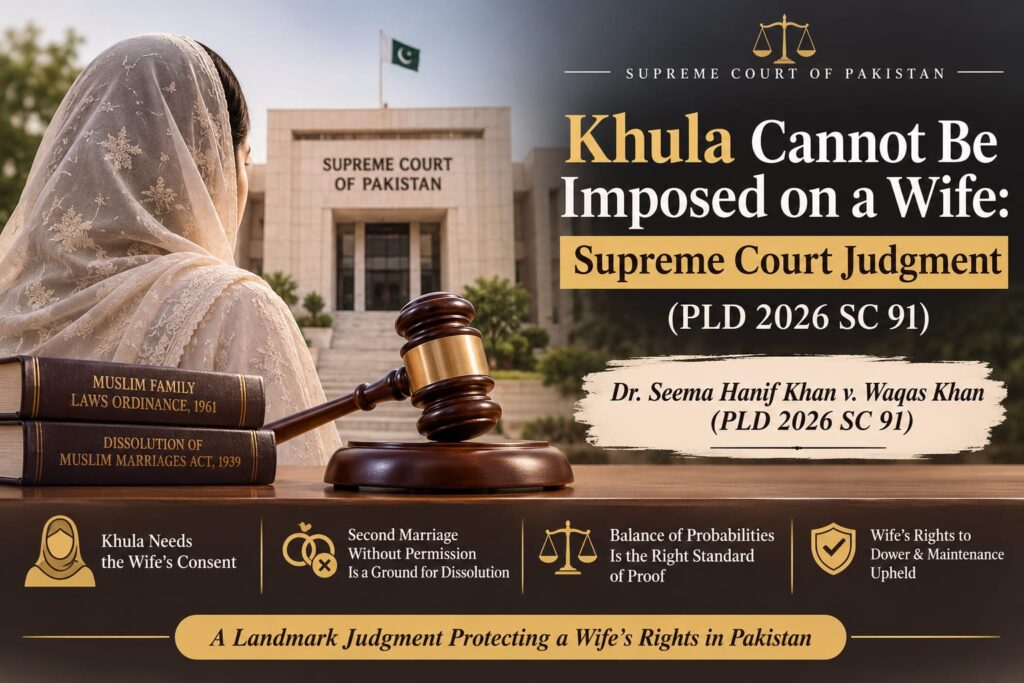
The Supreme Court of Pakistan has held that a family court cannot convert a wife’s suit for
dissolution of marriage into khula without her consent. In Dr. Seema Hanif Khan v. Waqas
Khan (PLD 2026 SC 91), the Court also confirmed that a husband’s second marriage
without lawful permission is enough to dissolve a marriage.
Case Details
Case: Dr. Seema Hanif Khan v. Waqas Khan and others
- Citation: PLD 2026 Supreme Court 91
- Bench: Justice Ayesha A. Malik and Justice Naeem Akhter Afghan
- Decided: 19 September 2025
- Arising from: Peshawar High Court order dated 27 May 2024
Background of the Case
The wife filed a suit for dissolution of marriage. Her husband had contracted a second
marriage without her consent or Arbitration Council permission. The Family Court granted
khula instead, which she never requested, and ordered her to return her dower. Her appeal
and writ petition were dismissed, and she approached the Supreme Court.
Grounds for Dissolution of Marriage Under the DMMA 1939
Section 2 of the Dissolution of Muslim Marriages Act, 1939 allows a wife to seek dissolution
if she proves one or more statutory grounds. These include;
- The husband’s disappearance
- Failure to provide maintenance (Section 2(ii))
- Imprisonment
- Impotence
- Insanity
- Cruelty (Section 2(viii))
- Taking an additional wife in violation of the law (Section 2(ii-a), inserted through
Section 6 of the Muslim Family Laws Ordinance, 1961)
The Court explained that each ground recognises that a husband’s conduct or
circumstances can impair the marital bond so badly that continuing it would be unjust to
the wife.
Key Findings of the Supreme Court
- Khula Needs The Wife Consent.
Khula is a separate remedy based on the wife’s voluntary decision to end the marriage and pay compensation. Filing a suit for dissolution is not a request for Khula. Converting one into the other without her consent is contrary to law, following Ibrahim Khan V. Mst. Saima Khan (PLD 2024 SC 645).
2. Second Marriage Without Permission Is A Sufficient Ground.
The husband violated Section 6 of the MFLO 1961, which triggers Section 2(ii-a) of the DMMA. This ground alone was enough to dissolve marriage.
3. Balance Of Probabilities Is The Correct Standard Of Proof.
The lower court rejected the wife’s claim of cruelty because she had no documents. The Supreme Court held that missing documentary proof is not conclusive. Courts must weigh all the evidence on the balance of probabilities. The husband’s version was accepted although he produced no supporting witness, which the court called the grave error.
Final Order of the Supreme Court
- The marriage is dissolved on the ground of the husband’s second marriage in
violation of law.
2. The wife keeps her dower: the gold, money and plot.
3.She is entitled to maintenance of Rs. 10,000 per month for the period the marriage subsisted, to be calculated and paid according to law.
Why This Judgment Matters
- It protects a wife’s autonomy and her right to dower and maintenance.
2-It confirms that an unauthorised second marriage is a standalone ground for dissolution.
3. It directs family courts to assess evidence fairly, especially in cruelty cases where paper proof is rarely available.
Need Help With Dissolution of Marriage or Khula in Pakistan?
If you are facing a family law matter involving dissolution of marriage, khula, dower or
maintenance, OSMANI LAW ASSOCIATES can guide you.
Contact us today for a consultation.
Cell & WhatsApp # +92- 321-2770225,
Website: www.osmanilaw.com,
Email: info@osmanilaw.com.